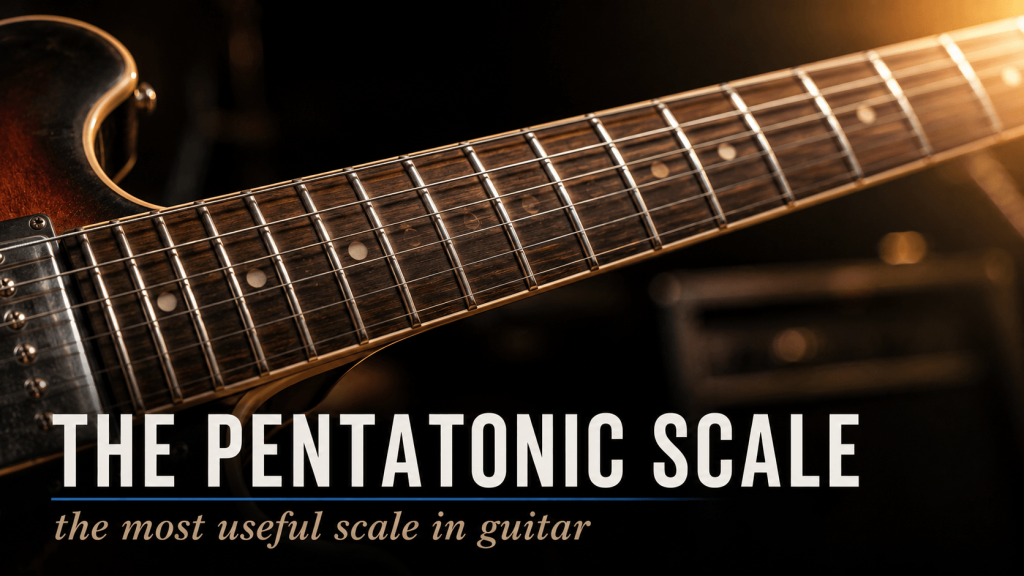
If you learn one scale on guitar, learn this one. The pentatonic scale is the single most useful scale a guitarist can know — the foundation of rock and blues lead playing, the source of countless famous solos and riffs, and, conveniently, one of the easiest scales to play and the hardest to make sound bad. It’s the scale that lets beginners experience the genuine thrill of improvising a solo far sooner than they’d expect.
This guide covers the pentatonic scale completely for a beginner: what it is and why it works so well, the all-important minor pentatonic shape, the major pentatonic, how the two relate, the blues note that turns it into the blues scale, and — the whole point — how to actually use it to improvise. Some basic familiarity with reading a fretboard diagram helps, but everything else starts from the ground up.
What the Pentatonic Scale Is
“Pentatonic” comes from the Greek for “five tones.” Where the major and minor scales you may have met use seven notes, the pentatonic uses only five. That’s the entire idea — it’s a five-note scale. And the magic is in which five notes get chosen and, just as importantly, which two get left out.
The pentatonic is essentially a regular seven-note scale with its two trickiest notes removed. In any given key, two of the seven scale notes are the ones most likely to clash with the underlying chords if you land on them at the wrong moment. The pentatonic scale simply drops those two. What’s left is five notes that sound good over almost any chord in the key, in almost any order. This is why the pentatonic is so forgiving: you can play its notes more or less however you like and it tends to sound musical, because the notes most likely to sound wrong have been removed in advance.
This forgiveness is exactly what makes the pentatonic the ideal scale for a beginner learning to improvise. With a seven-note scale, a beginner soloing will regularly hit one of the tricky notes at a bad moment and sound off. With the pentatonic, those landmines are gone — leaving a scale where a beginner can experiment, make up lines, and sound genuinely good with very little risk. It removes the fear from improvising.
Minor Pentatonic vs. Major Pentatonic
There are two main flavors of the pentatonic scale, and it’s worth understanding both, though one is far more commonly the beginner’s starting point.
The minor pentatonic — the rock and blues king
The minor pentatonic is the famous one — the scale behind the vast majority of rock and blues guitar solos. It has a slightly dark, edgy, soulful character that fits rock, blues, hard rock, and metal perfectly. When you imagine an electric guitar wailing out a bluesy solo with string bends and expressive licks, you’re almost certainly imagining the minor pentatonic scale. Its five notes are the root, the flattened third, the fourth, the fifth, and the flattened seventh — but you don’t need to memorize that to use it. You need the shape, which we’ll get to.
The major pentatonic — bright and sweet
The major pentatonic has a brighter, happier, sweeter sound, and it’s common in country, pop, folk, and major-key rock. It uses the root, second, third, fifth, and sixth of the major scale. It’s the same idea — five forgiving notes — but with a major, uplifting character rather than the minor’s bluesy edge. Many country and pop lead lines live in the major pentatonic.
The shortcut: they’re the same shape
Here’s a genuinely useful piece of guitar knowledge: the minor pentatonic and the major pentatonic use the exact same fingering shapes. The only difference is where the root note is — that is, which note you treat as home. The major pentatonic shape is the minor pentatonic shape relocated by three frets (or, equivalently, the same shape with a different note understood as the root). This means that by learning the minor pentatonic shapes, you’ve simultaneously learned the major pentatonic shapes — they’re physically identical, just anchored to a different root. This is the same relative major/minor relationship that connects the full major and minor scales, and it’s why learning the pentatonic gives you so much for so little effort.
The Most Important Shape: Minor Pentatonic, Position 1
If there’s one scale shape every guitarist knows, it’s this one — the first position (often called “box 1” or “the home position”) of the minor pentatonic. It’s the most-played scale shape in rock and blues, and learning it is a genuine milestone for any beginner.
The shape spans all six strings and uses two notes per string, forming a compact, symmetrical box pattern that’s easy to memorize. Played in the key of A minor, it sits at the 5th fret. The notes of A minor pentatonic are A, C, D, E, and G — but again, what you actually learn is the shape, which lets you play those notes without thinking about their names.

Here’s the box-1 pattern in A minor (at the 5th fret). On each string, the two numbers are the frets you play:
- Low E string: 5th fret, 8th fret
- A string: 5th fret, 7th fret
- D string: 5th fret, 7th fret
- G string: 5th fret, 7th fret
- B string: 5th fret, 8th fret
- High E string: 5th fret, 8th fret
Notice the symmetry: it’s 5-8, 5-7, 5-7, 5-7, 5-8, 5-8 — almost the same on every string, which is what makes it so easy to remember. The root notes (the A notes that name the scale) are on the low E string 5th fret, the D string 7th fret, the G string… and the high E string 5th fret. Knowing where the roots are matters for soloing, but to start, just learn the box and play it up and down.
| The movable magic: This shape is movable, exactly like a power chord. Slide the whole box so your index finger starts on a different fret, and you’re playing the minor pentatonic in a different key. Start the box at the 5th fret = A minor pentatonic. Start it at the 3rd fret = G minor pentatonic. Start it at the 7th fret = B minor pentatonic. One shape, every key — just move it so the lowest root lands on the note you want. |
How to Find the Right Key
To use the pentatonic over a song, you need the box in the right key — and that comes down to where you place the shape. The lowest root note of box 1 sits under your index finger on the low E string. The note at that fret is the key of your scale. So if you want A minor pentatonic, put that finger on the 5th fret of the low E string (which is an A). For G minor pentatonic, the 3rd fret (a G). For E minor pentatonic, the 12th fret (or the open position).
This is where knowing the note names on the low E string pays off — the same knowledge that makes power chords work. The notes on the low E string, fret by fret: F at 1, G at 3, A at 5, B at 7, C at 8, D at 10, E at 12. Place box 1 so its lowest root lands on the note matching the song’s key, and the scale will fit. (Whether a song is in a major or minor key takes a little ear training to determine, but for jamming with backing tracks, the track will usually tell you its key.)
The Blues Note: Turning Pentatonic Into the Blues Scale
Here’s a small addition that unlocks a whole world of expressive playing. Take the minor pentatonic scale and add one extra note — a single passing note between the fourth and fifth notes of the scale — and you get the blues scale. That added note is called the “blue note,” and it’s responsible for the distinctively gritty, soulful, bluesy sound.
The blue note is special because it’s a passing note — it sounds great when you move through it quickly but tends to clash if you sit on it. Used as a quick passing tone, it adds enormous expressive flavor; the bends and slides that define blues and rock lead guitar very often pass through this note. Adding the blue note to your pentatonic box is a small change that dramatically expands the emotional range of what you can play, and it’s a natural next step once the basic minor pentatonic is comfortable.
In the A minor pentatonic box at the 5th fret, the blue note adds a note on a couple of strings within the existing shape — most notably, it sits on the A string and the high strings between the box’s existing notes. Many players learn the blues scale as “the pentatonic box with one extra note added,” which is exactly what it is. Learn the pentatonic first; add the blue note once the box is solid.
How to Actually Use It: Improvising
Knowing the shape is worthless until you use it to make music. Here’s how to go from playing the box up and down to actually improvising, which is the entire reason the pentatonic is worth learning.
- Get a backing track. Search for a “backing track in A minor” (or any key you like). There are endless free ones in every style and tempo. Pick one that sounds good to you.
- Put the box in the matching key. For an A minor backing track, place box 1 at the 5th fret. Now every note in that box will sound good over the track.
- Play around — you literally cannot hit a wrong note. Start by just playing notes from the box over the track, in any order, any rhythm. Because the pentatonic is so forgiving, it will sound musical almost immediately. This is the moment most students realize they can improvise.
- Leave space and repeat ideas. Good soloing isn’t a constant stream of notes. Play a short phrase, leave a gap, play another. Repeating and varying small phrases sounds far more musical than running the scale up and down. Space is part of the music.
- Add bends and slides. Once you’re comfortable, start bending notes up and sliding between them. These expressive techniques are what make pentatonic soloing sound like real lead guitar rather than scale practice.
This is the magic of the pentatonic and the reason to learn it first. Within a single practice session of placing the box over a backing track, a beginner can genuinely improvise and sound good. No other scale delivers that experience so quickly, and that early taste of real music-making is what motivates students to keep going and learn more.
Beyond Box 1: The Other Positions
Box 1 is the beginning, not the end. The minor pentatonic scale actually covers the entire fretboard, and box 1 is just one of five connected positions (boxes) that link together up and down the neck. Each box is the same scale in a different region, and they interlock so that you can play the pentatonic anywhere on the neck and move smoothly between positions.
For a beginner, box 1 alone is enough to start improvising and to play a great deal of music — don’t feel you need all five positions before you can make music. But as you progress, learning the other boxes (and how they connect) frees you from being stuck in one region of the neck and lets your soloing roam across the whole fretboard. Learn box 1 deeply first, use it to make music, then expand to the neighboring positions one at a time.
Common Pentatonic Mistakes
- Running the box up and down mechanically. Playing the scale straight up and down over and over isn’t soloing — it’s drilling. Use the notes to make phrases, leave space, repeat ideas. Music, not exercises.
- Never applying it to a backing track. The pentatonic only comes alive over music. If you only ever play it unaccompanied, you miss the entire point. Get a backing track immediately.
- Learning five boxes before using one. Box 1 alone is enough to improvise. Master it and make music with it before worrying about the other positions.
- Wrong key. Placing the box at the wrong fret for the backing track makes even correct playing sound off. Match the box’s root to the track’s key.
- Sitting on the blue note. The blue note is a passing tone — move through it, don’t camp on it, or it clashes. Quick passes sound great; lingering sounds wrong.
The Takeaway
The pentatonic scale is the most useful scale in guitar for a simple reason: it gives the most musical reward for the least effort. Five forgiving notes, one easy movable box shape, and you can improvise rock and blues solos that sound genuinely good — often within a single practice session. It’s the foundation of lead guitar and the fastest route to the thrill of making up your own music.
Learn box 1 of the minor pentatonic, learn where to place it for different keys, and — above all — apply it to backing tracks immediately so it becomes music rather than a drill. Add the blue note for expressive blues flavor once the box is solid, and expand to the other positions over time. More than any other single thing in this guide, the minor pentatonic box over a backing track is the moment a beginner stops feeling like a student and starts feeling like a guitarist. Learn it, plug into a track, and go play.

Further Reading
- Guitar Scales for Beginners — the pillar guide to scales, where the pentatonic fits among the others
- Power Chords for Beginners — uses the same low-E-string root-note knowledge as placing the pentatonic box
- Guitar Chords for Beginners — the chords that the pentatonic is played over
- How to Play Guitar: A Complete Beginner’s Guide — the full beginner foundation