Scales have an image problem. To a lot of beginners, they sound like the homework of guitar — dry, technical, the boring vegetables you’re supposed to eat before the fun of playing actual songs. That reputation is unearned, and it costs students dearly, because scales are quietly the thing that turns a chord-strummer into a musician who understands what they’re playing.
This is a complete beginner’s guide to guitar scales: what a scale actually is, why they matter more than their reputation suggests, the three scales worth knowing first, how the patterns work on the fretboard, and — crucially — how to practice them so they improve your playing instead of becoming mechanical finger drills. No music degree required. If you can fret a note and read a simple diagram, you can start here.
What a Scale Actually Is
A scale is simply a set of notes that sound good together, arranged in order from low to high. That’s it. When you play the notes of a scale in sequence, you get that familiar rising or falling run of pitches. When you build chords and melodies from those same notes, they sound like they belong together — because they’re drawn from the same family.
The reason scales matter is that nearly all music is built from them. The chords in a song, the melody of the vocal line, the notes a guitarist plays in a solo — overwhelmingly, these come from a single scale that the song is built around. Understanding scales is understanding the raw material that songs are made of. It’s the difference between knowing a few chord shapes and understanding why those chords sound good together and what notes will fit when you want to play a melody or a solo over them.
Think of a scale as a palette. A painter doesn’t use every possible color in one painting; they choose a palette of colors that work together. A scale is the musical equivalent — a curated set of notes that sound coherent together, which the songwriter or improviser draws from. Once you know the palette a piece of music is using, you know which notes will sound right and which will sound wrong, which is the foundation of playing melodies, improvising, and understanding songs.
Why Beginners Should Learn Scales (Not Just Chords)
Most beginners learn chords and stop there, treating scales as an advanced topic for later. That’s a mistake, and here’s what learning scales early actually gives you:
- The ability to play melodies and solos. Chords are the accompaniment; scales are where melodies and solos come from. If you ever want to play a riff, a lead line, or improvise, scales are the source.
- Finger strength and dexterity. Practicing scales is also a workout for your fretting hand. The independent finger movement scales require building the coordination that makes everything else on the guitar easier.
- Fretboard knowledge. Scales teach you where the notes are and how the fretboard is organized. Students who only learn chord shapes often have no idea what notes they’re actually playing; scales fix that.
- An understanding of why music works. Once you see that the chords in a song and the melody over them come from the same scale, songs stop being mysterious collections of shapes and start making sense as coherent musical structures.
- Ear training. Playing scales trains your ear to recognize the intervals and patterns that recur throughout music, which gradually lets you figure out songs by ear.
You don’t need to master scales before playing songs — keep playing songs, that’s where the joy is. But weaving a little scale practice into your routine from early on pays compounding dividends. Ten minutes of scales a few times a week, alongside your chord and song practice, builds a foundation that makes you a genuinely more capable musician over months.
How Scales Are Built: A Gentle Bit of Theory
You can play scales without any theory, but a small amount of understanding makes them far less arbitrary. Here’s the gentlest possible version.
The distance between two adjacent frets on the guitar is called a half step (or semitone). Two frets is a whole step. Every scale is defined by a specific pattern of whole steps and half steps. That pattern is what gives each type of scale its distinctive sound, and — this is the powerful part — the same pattern can start on any note, which is why one scale shape works all over the neck.
Don’t worry about memorizing the step patterns right now. The point to absorb is just this: a scale is a fixed pattern of distances, not a fixed set of notes. Move the pattern to a different starting note, and you get the same type of scale in a different key. This is why, on guitar, a single fingering shape gives you a scale starting wherever you place it — the shape is the pattern made physical. We’ll see this clearly with the pentatonic scale below.
Scale 1: The Major Scale (The Foundation of Everything)
The major scale is the most important scale in Western music — the one most other musical ideas are measured against. It’s the “do-re-mi-fa-sol-la-ti-do” you’ve heard your whole life. That ascending sequence of seven notes (the eighth returns you to the start an octave up) has a bright, resolved, happy character, and it’s the reference point from which all other scales are understood.
Most popular music in a major key is built from the major scale: the chords come from it, the melodies come from it. Learning the major scale gives you the framework that the majority of songs you know are built on. It’s also the scale that music theory uses as its baseline — minor scales, modes, and everything else get described in terms of how they differ from the major scale.
As a beginner, learning one major scale shape and being able to move it around the neck is a significant milestone. It teaches your fingers a fundamental pattern and your ear the most basic sound in Western music. It’s worth learning early, even though — full honesty — it’s not the scale you’ll reach for first when you want to play a cool-sounding solo. That honor goes to the pentatonic, coming up shortly.
Scale 2: The Minor Scale (The Other Side of the Coin)
If the major scale is bright and happy, the natural minor scale is its darker, more melancholy counterpart. Same idea — seven notes in a fixed pattern — but a different pattern of whole and half steps that produces a sadder, more serious, more dramatic character. A huge amount of rock, metal, and emotionally weighty music lives in minor keys.
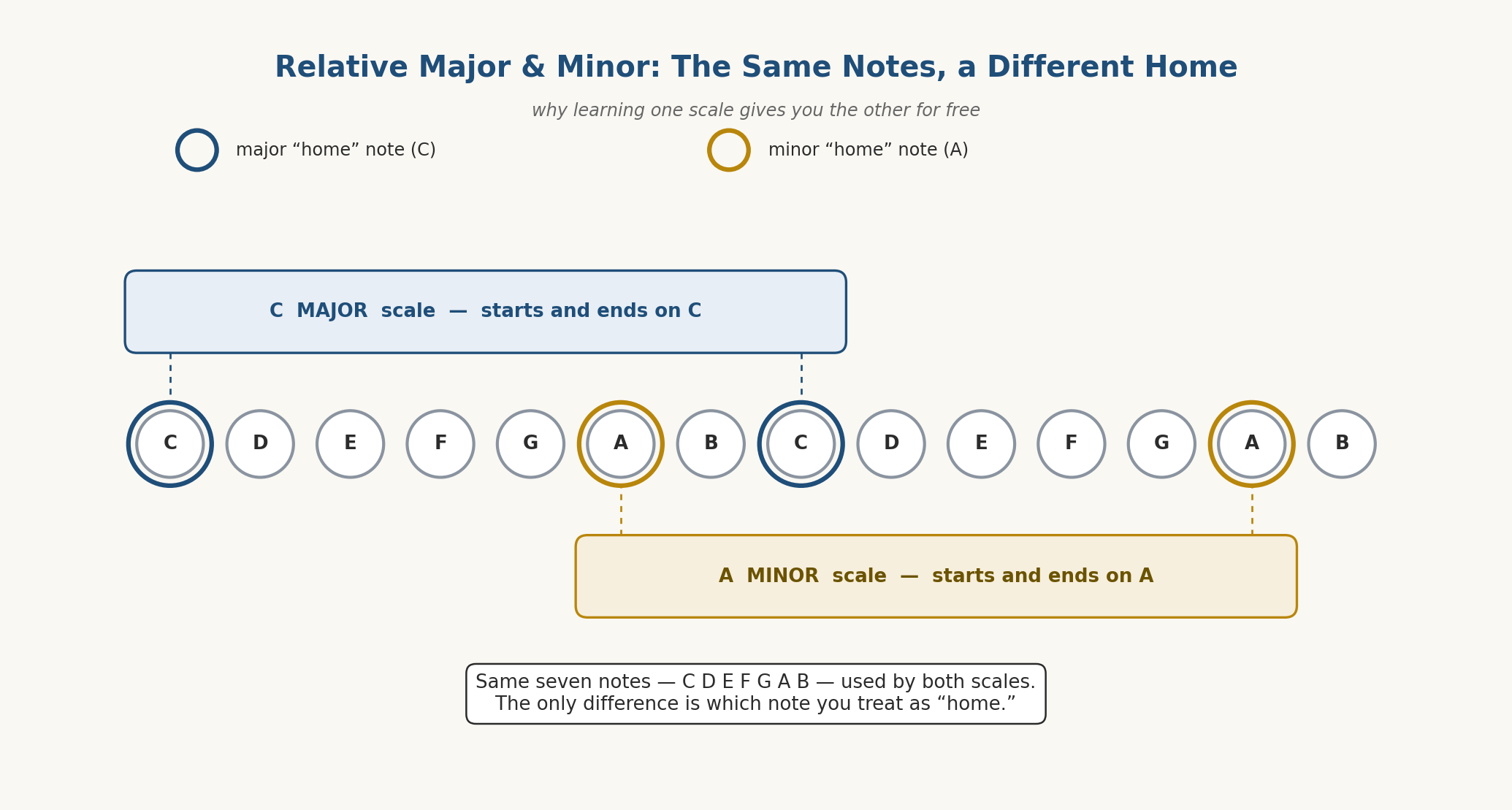
Here’s a relationship worth knowing because it makes minor scales much easier: every major scale contains a minor scale hiding inside it, starting from a different note. The natural minor scale uses exactly the same notes as a major scale — it just treats a different note as home. This means that if you’ve learned a major scale shape, you’ve already learned the related minor scale; you just start and end in a different place. This relationship (called relative major and minor) is one of the genuinely useful pieces of theory for a beginner, because it halves the amount you have to learn.
For most beginners, the natural minor scale is worth learning right after the major scale, both because so much music uses it and because understanding the major-minor relationship deepens your grasp of how scales work in general.
Scale 3: The Pentatonic Scale (The One You’ll Actually Use Most)
Here’s the scale that beginners often should have started with: the pentatonic scale. “Penta” means five — the pentatonic scale uses only five notes instead of the major and minor scales’ seven. And those five notes are chosen so that essentially none of them sound bad over a typical chord progression, which makes the pentatonic scale the most forgiving, most useful, and most beginner-friendly scale of all.
The pentatonic is the scale behind the overwhelming majority of rock and blues guitar solos. When you hear a guitarist improvising a lead — the bends, the licks, the iconic rock and blues phrases — they’re very often playing a pentatonic scale. It’s the workhorse of lead guitar, and it’s deliberately simple: by dropping the two notes from the seven-note scale that are trickiest to use, the pentatonic becomes a scale where you can play almost any note in any order, and it sounds musical.
This is why many teachers now start beginners on the pentatonic rather than the major scale. It delivers the satisfying experience of improvising and soloing far sooner, with far less risk of hitting a wrong-sounding note. There are two main forms — the minor pentatonic (the rock and blues favorite) and the major pentatonic (brighter, common in country and pop) — and a single movable shape unlocks each one across the whole neck. The pentatonic scale gets its own complete guide, because it’s the scale most worth knowing in depth: see Pentatonic Scale Guide for the shapes, the soloing applications, and the blues connection.
| If you only learn one scale first: Make it the minor pentatonic. It’s the easiest to play, the hardest to make sound bad, and the foundation of rock and blues lead guitar. It delivers the fun of improvising sooner than any other scale, which keeps you motivated to learn the others. |
How Scale Shapes Work on the Fretboard
Guitar has a wonderful advantage over many instruments when it comes to scales: because of how the fretboard is laid out, a scale is a physical shape you can move around. Learn the shape once, and you can play that scale starting on any note simply by sliding the shape to a different position. The pattern of your fingers stays identical; only the location changes.
This is why guitarists talk about scale “shapes” or “boxes” or “positions.” A scale shape is a map of which frets to play on which strings, relative to a starting point. Once the shape is in your fingers, you don’t think about individual notes — you think about the shape, and you move it to wherever you need the scale to start. This is the same movability you may have met with barre chords and power chords, applied to scales.
For a beginner, this means learning scales is largely learning a handful of shapes and the ability to move them. You don’t memorize hundreds of individual notes; you memorize a few patterns and where to put them. The pentatonic scale, in particular, has one famous shape that, once learned, gives you the scale anywhere on the neck — which is a big part of why it’s so beginner-friendly.
How to Practice Scales (So They Actually Help)
Scales practiced mindlessly become boring finger drills that don’t transfer to real playing. Scales practiced well become the foundation of your musicianship. The difference is in how you practice:
- Use a metronome and go slow. Scales are perfect for building timing. Play each note exactly on the beat, slowly, evenly. Speed comes later; clean and in-time comes first.
- Say or hear the notes. Don’t just move your fingers — try to hear each note, and ideally know its name. This connects the physical shape to the actual music, which is what makes scales useful rather than mechanical.
- Practice ascending and descending. Play the scale up and back down. Descending is often harder and gets neglected; give it equal time.
- Apply the scale to music. This is the step that’s almost always skipped and matters most. Put on a backing track in the scale’s key and try playing the scale’s notes over it — improvise, even badly. This turns scale practice from drilling into music-making, and it’s where scales finally click.
- Keep it short and regular. Ten minutes of focused scale practice several times a week beats an hour once a month. Fold it into your routine alongside chords and songs.
That fourth point deserves emphasis. The students who find scales boring are almost always the ones practicing them in isolation, as pure finger exercises disconnected from music. The students who find scales genuinely exciting are the ones using them to improvise over backing tracks — because that’s when a scale stops being homework and becomes the thing that lets you make up your own music on the spot. Connect scales to actual playing as early as possible.
Common Scale Mistakes
- Practicing scales in isolation forever. Drilling shapes without ever applying them to music. Apply scales to backing tracks early — that’s the entire point.
- Chasing speed too soon. Fast, sloppy scales build bad habits. Slow, clean, in-time scales build real ability. Speed is a byproduct of clean practice, not a goal to force.
- Learning too many scales at once. Better to know one scale deeply and be able to use it musically than to half-know five. Start with the minor pentatonic, learn it thoroughly, then expand.
- Memorizing shapes without hearing them. A scale you can play but can’t hear is just a finger exercise. Always try to hear the notes; that’s what connects the shape to music.
- Skipping scales entirely. The most common mistake of all — treating scales as optional. They’re the foundation of melody, soloing, and understanding music. A little scale practice early pays off enormously over time.
Where to Start: A Simple Plan
If you’re convinced scales are worth your time and want a concrete starting point, here’s the order that works for most beginners:
- Start with the minor pentatonic. Learn the one famous shape (covered in detail in our Pentatonic Scale Guide). It’s the easiest, most useful, and most rewarding first scale.
- Apply it immediately. Find a backing track in the same key and improvise over it using only the scale’s notes. Experience the fun of soloing early — it’s the motivation that carries you through learning the rest.
- Add the major scale. Once the pentatonic is comfortable, learn a major scale shape to understand the foundational sound of Western music and the framework most songs are built on.
- Learn the major-minor relationship. Discover how the natural minor scale lives inside the major scale, which gives you minor scales nearly for free and deepens your understanding.
- Expand gradually. From this foundation, additional pentatonic positions, the full major and minor patterns across the neck, and eventually modes and other scales all build naturally.
The Takeaway
Scales aren’t the boring homework of guitar — they’re the raw material of melody, the source of every solo, the key to understanding why music works, and a genuine workout for your hands and ears. Their dull reputation comes entirely from being practiced badly, in isolation, disconnected from music. Practiced well — slowly, musically, and applied to real playing — they’re one of the most rewarding things you can work on.
Start with the minor pentatonic because it’s easy, forgiving, and immediately fun to improvise with. Apply it to backing tracks from day one so it never feels like a drill. Add the major scale and its minor relative as you progress. Keep scale practice short, regular, and always connected to actual music. Do that, and scales will quietly transform you from someone who plays memorized shapes into someone who understands the instrument, which is the whole difference between a beginner and a musician.
Further Reading
- Pentatonic Scale Guide — the most important scale, in full detail: shapes, soloing, and the blues connection
- Guitar Chords for Beginners — how chords and scales come from the same musical material
- How to Play Guitar: A Complete Beginner’s Guide — where scales fit in the full beginner picture
- How to Switch Chords Faster — the fretting-hand dexterity that scale practice also builds