Struggling to navigate the guitar fretboard? Discover the 4 magic chords that will unlock the secrets of the fretboard and take your playing to the next level.
Unlock the Fretboard with These 4 Magic Guitar Chords
Hey there, Rotem Sivan here. As a professional guitarist, I know firsthand how daunting it can be to navigate the vast world of guitar chords. When I first moved to New York, I felt overwhelmed by the seemingly endless array of chords I thought I needed to master. However, I discovered a simple system that unlocked the fretboard for me, and I’m excited to share it with you today.
Understanding Guitar Chords
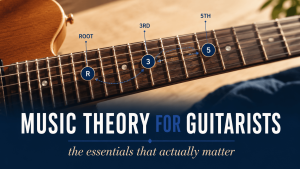
Before we dive into the magic chords, let’s take a moment to understand what a chord really is. In its most basic form, a chord is constructed from three notes: the root (1), the third (3), and the fifth (5). These numbers represent the notes’ positions within a scale. For example, in the key of C major, the notes would be C (1), E (3), and G (5).
To hear the difference between chord qualities, let’s compare C major (C, E, G) and C minor (C, Eb, G). Pay attention to how each chord makes you feel. Now, let’s expand our chord vocabulary by adding the seventh note to create 7th chords. A C major 7 chord would consist of C (1), E (3), G (5), and B (7).
Knowing the Notes on the Fretboard
To effectively use chords across the guitar neck, it’s crucial to know the notes on the 6th and 5th strings. Understanding the concept of half steps (the distance between each fret) will help you navigate the fretboard more easily.
Let’s take a look at the C major scale on the guitar. Starting from the 8th fret of the 6th string (the low E string), you’ll find the notes C, D, E, F, G, A, and B. Notice how the pattern repeats at the 20th fret, an octave higher. Recognizing these octave shapes will help you see the fretboard as a mirror image, making it less intimidating.
Listening and Comparing Guitar Chord Qualities
One of the most important aspects of mastering chords is developing your ear. Take the time to listen and compare the sounds of different chord qualities. Play a C major 7, C7, C minor 7, and C diminished chord, and pay attention to how each one makes you feel. This exercise will help you associate certain emotions with specific chord types, enhancing your musical expression.
Shell Guitar Chords: The Essential Notes
Now, let’s talk about shell chords. These chords consist of the most essential notes needed to convey a chord’s quality. In a shell chord, we focus on the root (1), the third (3), and the seventh (7). The third note determines whether the chord is major or minor, while the seventh note adds depth and character.
By stripping chords down to their shell voicings, you can simplify your playing while still maintaining the essence of the harmony.
Mastering One Shape at a Time
To get started with shell chords, let’s focus on one shape at a time. Begin with the C major 7 shape, then move on to the F major 7 shape. As you practice transitioning between these two chords, try adding embellishments like hammer-ons or bass notes to create a more melodic and interesting progression.
Remember, the goal is to make music, even with simple chord progressions. Focus on playing in time and adding your own creative touches.
The Four Magic Shell Guitar Chord Shapes
Now, let’s talk about the four magic shell chord shapes that will unlock the fretboard for you. These shapes are:
- C major 7
- C7
- C minor 7
- C diminished
Once you’ve mastered these shapes, you can apply them to different root notes on the 6th and 5th strings. This will allow you to play a wide variety of songs and chord progressions using just these four versatile shapes.
Adding Extensions to Shell Guitar Chords
As you become more comfortable with shell chords, you can start adding extensions to create more complex and colorful voicings. Extensions are notes that go beyond the 7th degree of the scale, such as the 9th, 11th, and 13th.
For example, you can add the 9th note to a C major 7 shell chord to create a C major 9 chord. Experiment with different extensions and discover how they can add depth and sophistication to your playing.
Practical Applications and Examples
Now that you’ve learned the four magic shell chord shapes and how to add extensions, it’s time to put them into practice. Take a look at some popular chord progressions and see how you can apply your new knowledge to navigate the fretboard more efficiently.
Don’t be afraid to experiment with different chord voicings and extensions. The more you explore, the more you’ll develop your own unique sound and style.

FAQs
What is the worst song in the world?
That’s a great question! I’d love to hear your thoughts. Please drop a comment with your pick for the worst song in the world. I’m always looking for new ideas for guitar arrangements, and tackling the worst song could be a fun challenge.
Do you like the hat?
I’m curious to know what you think about the hat. Drop a comment and let me know if you think I should keep wearing it or not. Your opinion matters to me!
Are you feeling stuck with guitar?
If you’re feeling stuck with your guitar playing, I have a solution for you. I’ve created a comprehensive workshop that covers everything from scales and chords to singing, listening, and practicing effectively. It’s the workshop I wish I had when I first started playing. Be sure to check it out if you’re serious about improving your guitar skills.
Mastering the guitar fretboard may seem intimidating at first, but by understanding the power of shell chords and focusing on the four magic shapes, you’ll be well on your way to unlocking its secrets. Remember to practice regularly, listen attentively, and always strive to make music, even with simple progressions.
I hope this article has provided you with valuable insights and practical tips to help you navigate the fretboard with confidence. Keep exploring, keep creating, and most importantly, keep enjoying the journey of playing guitar.
Visit my website: rotemsivan.com.
Join me on Patreon: patreon.com/Rotem/Sivan
See you guys soon! Peace Out