Music theory has a fearsome reputation among guitarists — a dense thicket of notation, Italian terms, and academic rules that seems designed to suck the joy out of playing. A lot of players proudly avoid it, and a lot of others feel vaguely guilty for not knowing it. Both groups are working from the same misunderstanding: that theory is a set of rules you must obey, rather than a set of explanations for why the music you already love sounds the way it does.
Here’s the reframe that changes everything: music theory isn’t rules, it’s a map. It explains why certain chords sound good together, why a solo fits over a progression, why a song feels happy or sad. You don’t need much of it, and you don’t need it to be complicated. This guide covers the essentials that genuinely make you a better guitarist — the notes, intervals, how chords are built, scales, and keys — explained in plain language, with the guitar-specific shortcuts that make theory far easier on our instrument than on most. No notation-reading required.
Why Theory Is Worth a Little of Your Time
Let’s be honest about the value proposition, because “you should learn theory” without a reason is exactly the joyless obligation that puts players off. Here’s what a little theory actually gives you:
- You understand why things work. Instead of memorizing disconnected chord shapes and scale patterns, you see how they relate — which turns a pile of shapes into a coherent system you can navigate.
- You can figure out songs faster. Knowing which chords are likely to appear in a key lets you work out songs by ear far more quickly, because you know what to expect.
- You can write and improvise. Theory is the toolkit for making your own music — knowing which chords go together and which notes fit over them is the foundation of writing songs and soloing.
- You can communicate with other musicians. When someone says “it’s a I-IV-V in G,” theory is what lets you understand and join in rather than standing there lost.
Crucially, you need much less theory than you might fear. A handful of core concepts covers the vast majority of what’s useful for a playing guitarist. You do not need to read standard notation, memorize every mode, or study four-part harmony to get the real benefits. This guide sticks to the essentials that pay off, and skips the academic depth you can happily live without.
The Musical Alphabet
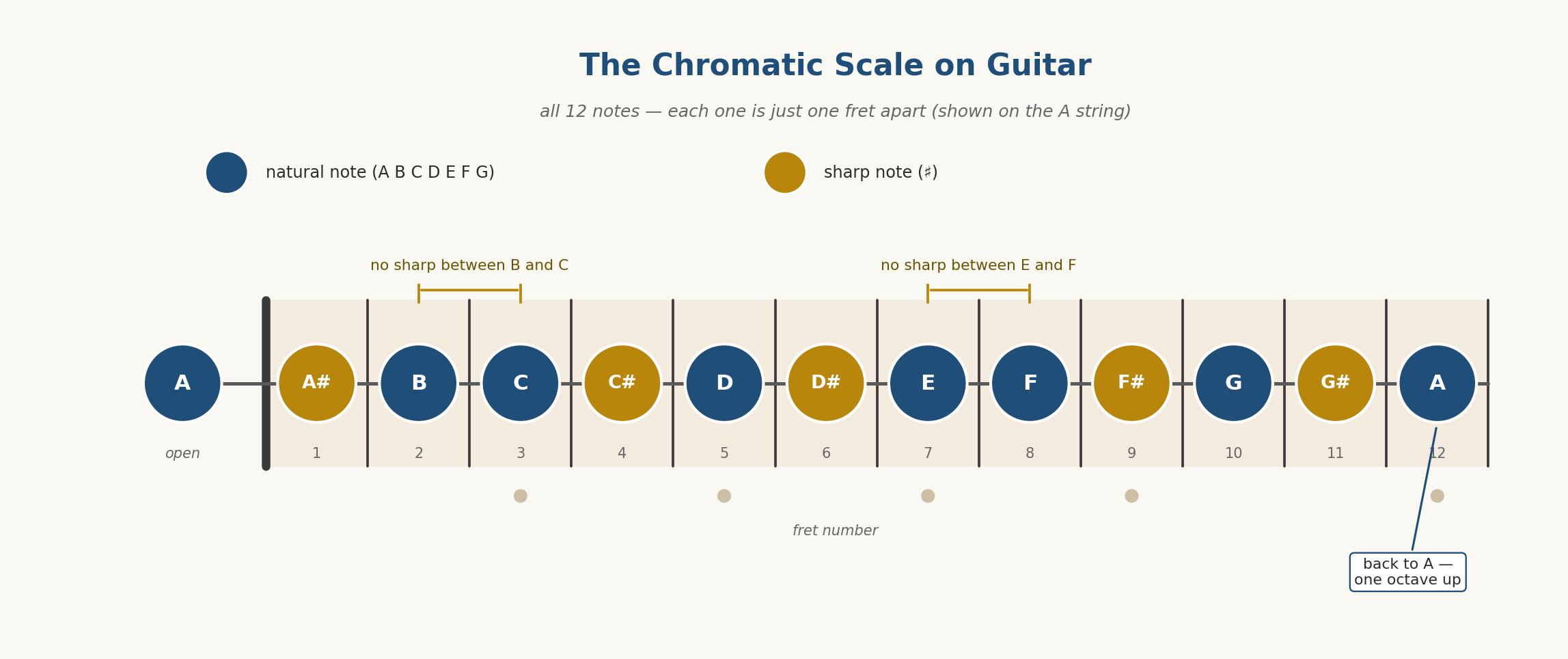
Everything starts here, and it’s simpler than you’d expect. Western music uses just twelve notes, and then they repeat. Seven of them have plain letter names: A, B, C, D, E, F, G. After G, it loops back to A. The other five notes sit between certain letters and are named with sharps (♯) or flats (♭) — the same note can be called by a sharp or a flat name depending on context, but it’s the same pitch.
On guitar, this maps onto the fretboard beautifully: each fret is one step up the twelve-note ladder. Move up one fret, you move up one note (a “half step”). Move up two frets, two notes (a “whole step”). This is the single most useful fact in guitar theory — the fretboard is a visual, physical layout of the musical alphabet, one note per fret. Learn the notes along one string (the low E, say) and you’ve got a reference point for the whole system.
One quirk worth knowing: between most letter notes there’s a sharp/flat note (one fret gap becomes two). But between B and C, and between E and F, there’s no note in between — they’re only one fret apart. This is just how the system evolved, and it explains a pattern you’ll notice everywhere once you know to look for it.
Intervals: The Distance Between Notes
An interval is simply the distance between two notes, and intervals are the real building blocks of music — more fundamental than individual notes, because music is about the relationships between notes, not the notes in isolation. The character of every chord and scale comes from its intervals.
You don’t need to memorize a table of interval names to benefit. The key idea is that the distance between two notes creates a specific sound and feeling, and that these distances are consistent everywhere. A particular interval sounds the same whether you play it starting on A or on G — which is exactly why guitar shapes are movable. A chord shape or scale shape is really a pattern of intervals, and because the intervals stay the same wherever you move the shape, the shape produces the same type of chord or scale anywhere on the neck.
This is the deep reason guitar is such a friendly instrument for theory: intervals are physical distances on the fretboard. The gap between your fingers in a chord shape is a set of intervals made visible. Move the whole shape and the intervals — and therefore the sound — come with it. On a piano, transposing means learning different physical patterns; on guitar, you just slide the same shape. This movability is a genuine gift, and it’s pure interval logic in action.
How Chords Are Built
Here’s where theory starts paying off visibly. A chord isn’t a random grab of notes — it’s a specific recipe of intervals stacked on a root note. Understanding the recipe turns chords from shapes you memorize into structures you understand.
The basic triad
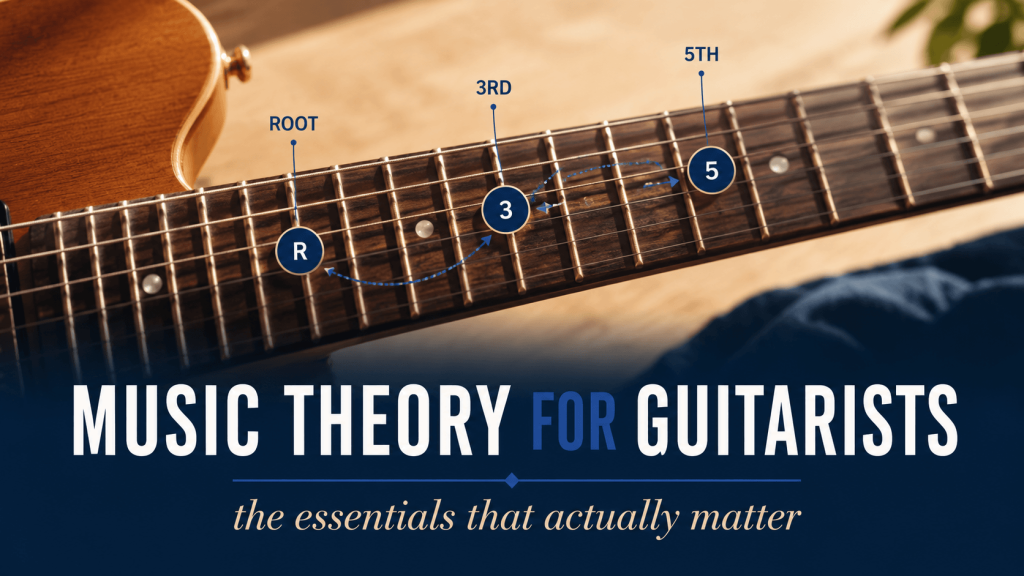
Most basic chords are triads — three notes. You take a root note (which names the chord), then add two more notes at specific intervals above it. The most important pattern: take the root, skip a note, take the next, skip a note, take the next — building the chord from every-other note of a scale. Those three notes stacked together are a triad, and they’re the foundation of the chords you already play.
Major vs. minor: one note’s difference
The difference between a major chord (bright, happy) and a minor chord (darker, sad) comes down to a single note — the middle note of the triad, called the third. Shift that one note down by a single fret’s worth of distance, and a major chord becomes minor. This is why major and minor chords of the same root feel like emotional opposites despite sharing two of their three notes: that one note, the third, carries the whole major-or-minor character. Once you know this, the difference between, say, a C major and a C minor stops being two unrelated shapes and becomes one small, logical change.
Beyond triads
Add more notes at further intervals and you get richer chords — sevenths (add one more stacked note, giving the bluesy, jazzy flavor of a G7), and beyond. You don’t need to master these to benefit from the concept; the point is simply that all chords are built by the same logic — a root plus notes stacked at intervals — and once you grasp the pattern, the entire universe of chords becomes a system rather than an endless list of shapes to memorize.
| The big idea: Chords are stacked intervals on a root note. Major or minor is decided by one note (the third). This single insight explains the relationship between hundreds of chord shapes and is arguably the highest-value piece of theory a guitarist can learn. |
Scales and Keys: The Home Base of a Song
A scale, as covered in depth in our scales guide, is a set of notes that sound good together, defined by a pattern of intervals. A key takes this one step further: a song in a particular key uses, for the most part, the notes and chords derived from that key’s scale. The key is the song’s home base — the family of notes and chords it’s built from.
Here’s the genuinely useful part. Because a key is built from a scale, the chords that naturally occur in that key are predictable. Every major key produces the same pattern of chord types built on each scale note: some major, some minor, in a fixed order. This is why so many songs share similar chord progressions — they’re drawing from the same predictable set of chords that a key provides. Once you know a song’s key, you can make a very good guess at which chords it uses, which is what makes figuring out songs by ear so much faster for players who understand keys.
The most common progression in music
Certain combinations of a key’s chords appear over and over because they sound satisfying. Musicians number the chords of a key with Roman numerals (I, IV, V, and so on) so a progression can be described independently of the specific key. The I-IV-V progression — the first, fourth, and fifth chords of a key — is the backbone of an enormous amount of blues, rock, folk, and pop. Learn to recognize it and you’ll suddenly hear it everywhere, and be able to play along with countless songs the moment you know the key. This is theory delivering immediate, practical payoff: one pattern, thousands of songs.
The Relative Major and Minor Relationship
One relationship is worth singling out because it’s both useful and elegant. Every major key has a “relative minor” key that uses exactly the same notes — the two keys are built from the same pool of notes, just treating a different note as home. This means the difference between a major key and its relative minor isn’t the notes; it’s which note feels like the center of gravity.
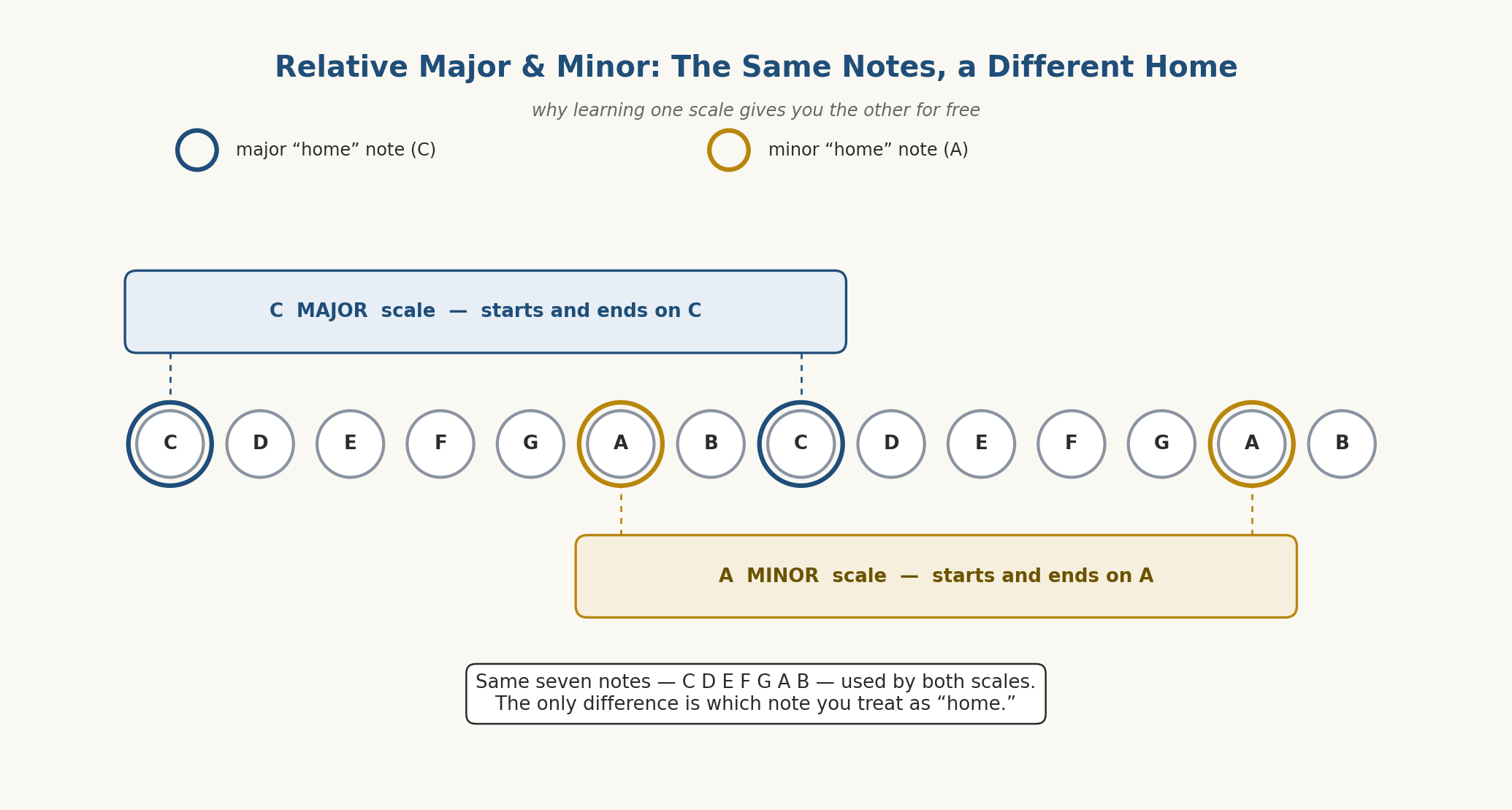
For guitarists, this is a practical gift. It means the scale shapes you learn for a major key work immediately for its relative minor — same notes, same fretboard positions, different emphasis. Learn one, and you’ve effectively learned two. It also explains why a single pentatonic box shape can be used as either a major or minor scale depending on context, a fact that makes soloing far more flexible once you understand it. Small relationship, large payoff.
What You Can Safely Ignore (For Now)
Just as useful as knowing what to learn is knowing what to skip. As a playing guitarist building practical theory, you can happily set aside — at least for now — the following, none of which is required to get the real benefits above:
- Reading standard notation. Useful for some purposes, but chord charts and tab cover most guitar needs. Don’t let notation-reading be a barrier to learning the useful concepts.
- Every mode and exotic scale. The major, minor, and pentatonic scales cover the vast majority of what you’ll play. Modes and beyond can wait until you have a specific reason to want them.
- Complex jazz harmony. Extended and altered chords are a rich world, but not one you need to enter to understand and enjoy most music. Come back to it if and when jazz pulls you in.
- Advanced rhythmic notation. You can develop excellent rhythm by feel and counting without formal notation. The theory of rhythm can come later.
None of these is useless — they’re all worth learning eventually if your musical path leads there. The point is that they’re not prerequisites. You can get the entire practical payoff of theory — understanding chords, keys, progressions, and how it all fits — without any of them. Don’t let the existence of advanced theory stop you from learning the useful basics.
How to Actually Learn Theory (Without the Overwhelm)
- Connect every concept to the fretboard. Theory sticks when it’s physical. Whenever you learn a concept, find it on the guitar and play it. Abstract theory fades; theory you’ve played stays.
- Learn it in the context of songs you know. Take a song you can play and figure out its key, its chords’ Roman numerals, why the chords work together. Theory applied to real music is memorable; theory in the abstract isn’t.
- Go slowly, one concept at a time. You don’t need to learn all of this at once. One concept, understood and applied, is worth more than ten concepts skimmed. There’s no rush.
- Use it immediately. The moment you learn a concept, use it — figure out a song’s key, build a chord from its intervals, spot a I-IV-V. Using theory is what turns it from information into understanding.
- Don’t aim for completeness. You’ll never “finish” music theory, and you don’t need to. Learn the useful bits, apply them, and add more only when a specific musical need arises. Practical beats comprehensive.
The Takeaway
Music theory for guitarists isn’t the intimidating academic subject its reputation suggests — it’s a practical map that explains why the music you love works, and the guitar’s fretboard makes it more visual and physical than on almost any other instrument. You need far less of it than you fear: the musical alphabet, the idea of intervals, how chords are built (and the one note that makes them major or minor), how scales create keys, and the predictable chord patterns that keys produce. That handful of concepts delivers nearly all the practical benefit.
Skip the notation-reading, the modes, and the jazz harmony until you have a reason to want them — they’re not prerequisites for understanding your instrument. Connect every concept to the fretboard, learn it through songs you already play, and use each idea the moment you learn it. Do that, and theory stops being the thing you feel guilty about avoiding and becomes exactly what it should be: the set of insights that makes you a more capable, more confident, more creative guitarist.
Further Reading
- Guitar Scales for Beginners — the pillar guide to scales, the foundation this theory builds on
- Pentatonic Scale Guide — the scale where the major/minor relationship becomes immediately practical
- Guitar Chords for Beginners — the chords whose construction this article explains
- Open Chords vs Barre Chords — movable shapes, which are interval patterns in action