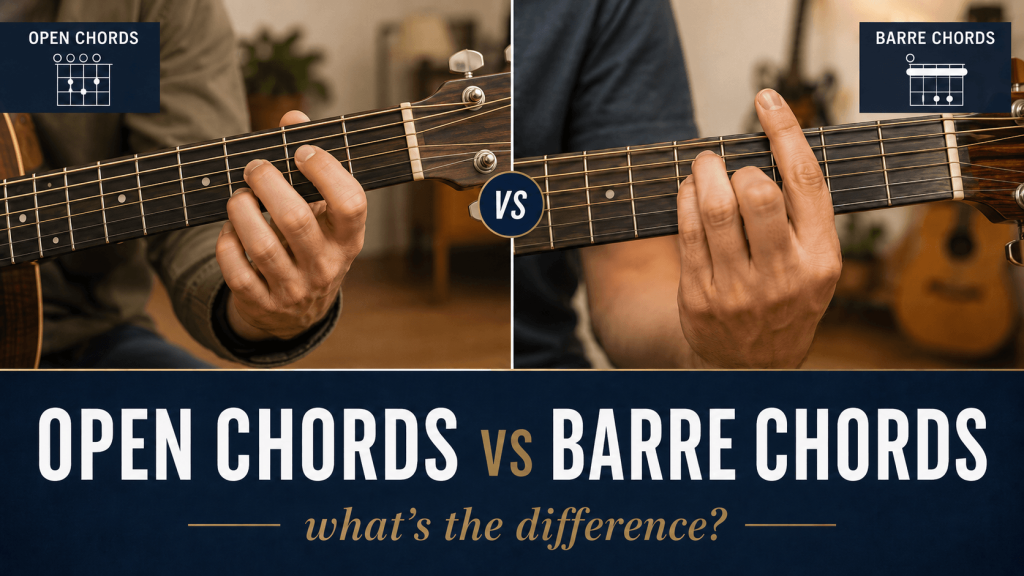
Early in learning guitar, you’ll hear two terms thrown around constantly: open chords and barre chords. Most beginners start with open chords, hit a wall when they first attempt barre chords, and wonder whether they’re doing something wrong. They’re not — barre chords are genuinely harder, for specific physical reasons, and understanding why makes the path through them much clearer.
This article explains what open chords and barre chords actually are, why barre chords are so much harder at first, when in your development to tackle them, and how the two types work together once you have both. It’s written for students moving from pure beginner toward early intermediate — the stage where this distinction starts to matter.
What Open Chords Are
Open chords are the first chords almost every guitarist learns — G, C, D, Em, Am, E, A, and the rest of the beginner set. They’re called “open” because they include open strings: strings that ring freely without any finger pressing them down.
In an open chord, your fingers press down a few strings in the first few frets, while one or more other strings ring open. That combination of fretted and open strings is what gives open chords their characteristic full, ringing, resonant sound. The open strings add richness that you don’t get when every string is fretted.

Open chords have two big advantages for beginners. First, they’re physically easier — you’re pressing only a few strings, each with a single fingertip, and the open strings require no effort at all. Second, they sound great with minimal effort, which is motivating early on. The downside, which becomes apparent later, is that open chords are mostly anchored near the top of the neck and can’t easily be moved around — which is exactly the problem barre chords solve.
What Barre Chords Are
A barre chord (sometimes spelled “bar chord”) is a chord where one finger — almost always the index finger — presses down multiple strings at once by lying flat across them, like a bar. The other fingers then form a shape on top of that barre.
The defining feature is that barre chords have no open strings. Every string that sounds is fretted, either by the barring index finger or by the other fingers. This is what makes them physically demanding: your index finger has to press several strings cleanly at once, which requires considerably more strength and precise positioning than pressing a single string.
The payoff for this difficulty is enormous: because a barre chord uses no open strings, the entire shape can slide up and down the neck to produce different chords. One barre shape, moved to different frets, gives you many different chords. This movability is the superpower of barre chords and the reason they’re worth the effort to learn, despite the early frustration.

Why Barre Chords Are So Much Harder
Almost every student finds their first barre chords dramatically harder than any open chord they’ve learned. This isn’t a sign of inadequacy — there are concrete physical reasons barre chords are harder, and knowing them helps you practice the right things.
Reason 1: One finger pressing multiple strings
Pressing a single string with a fingertip is relatively easy. Pressing six strings at once with one finger laid flat is a completely different demand. The index finger has to apply even pressure across its entire length, and any spot where the pressure is insufficient produces a buzzing or muted string. Building the strength and the precise positioning for a clean barre takes weeks of consistent practice — there’s no shortcut around developing that specific physical capacity.
Reason 2: The finger isn’t naturally flat or evenly hard
Your index finger has soft spots (the creases at the joints) and bony spots. When you lay it flat across the strings, the strings that happen to fall on a crease tend to get muted because the soft tissue doesn’t press them firmly. The solution is to roll the finger slightly toward its bony side and position it so the creases avoid the strings — a subtle adjustment that takes time to find and feels awkward at first.
Reason 3: It requires more overall hand strength
Barre chords demand more grip strength than open chords because your index finger is pressing hard across multiple strings while your other fingers simultaneously form a shape. This is genuinely a strength-building process — your hand has to develop muscles it hasn’t used before. Like any strength training, it takes weeks of consistent work, and pushing too hard too fast leads to strain rather than faster progress.
Reason 4: Thumb position becomes critical
With barre chords, the position of your thumb behind the neck matters more than it does for open chords. The thumb provides the counter-pressure that lets your index finger press firmly. If the thumb is poorly positioned — too high, wrapped over the neck — the barre won’t have enough counter-force and strings will buzz. Getting the thumb placement right is part of what makes barre chords click, and it’s why the posture fundamentals matter so much here.
| The encouraging truth: Every guitarist who can play barre chords effortlessly today struggled with them at first. The clean barre that seems impossible in week one becomes automatic with consistent practice — usually within a few weeks to a couple of months of regular work. It’s a strength and positioning skill that develops reliably with time, not a talent you either have or don’t. |
When Should You Learn Barre Chords?
The honest answer: not too early, but not too late either. There’s a sensible window.
Don’t rush into barre chords as a raw beginner. If you can’t yet form open chords cleanly and switch between them with some fluency, your hand isn’t ready for the additional demand of barring. Attempting barre chords before the open-chord foundation is solid usually produces frustration and poor technique, and can even discourage students into quitting. The open chords build the basic finger independence and hand position that barre chords then extend.
A reasonable readiness checkpoint: you can form the common open chords (G, C, D, Em, Am, E, A) cleanly, and you can switch between several of them in roughly real time. At that point — typically somewhere in the second or third month of consistent practice — your hand has the foundation to start working on barre chords. Some students get there faster, some slower; the checkpoint is about capability, not a calendar date.
Don’t put barre chords off indefinitely. Many songs simply require them — particularly chords like F major and B major that are awkward or impractical to play as open chords. Avoiding barre chords entirely limits the songs you can play and caps your development. Once the open-chord foundation is solid, starting barre-chord practice — even slowly, even badly at first — is the right move.
The F Chord: The Classic First Barre
For most students, the F major chord is the first barre chord they encounter, and it’s infamous. The full F major barre chord requires barring all six strings at the first fret with the index finger, while three other fingers form a shape on top. It’s the chord that makes many beginners feel like they’ve hit a brick wall.
If full F is defeating you, there are legitimate stepping stones. A partial F (barring only the top few strings) sounds acceptable in many songs and is much easier. Some players use a “mini F” or a thumb-over version as a temporary substitute while building toward the full barre. None of these are cheating — they’re sensible intermediate steps that let you keep playing songs while your barre strength develops. Many experienced players still use simplified F voicings in certain contexts.
The path through F is the same as the path through all barre chords: consistent, patient practice with attention to index-finger positioning and thumb placement. The wall is real, but everyone who plays barre chords today got over exactly this wall. It’s a rite of passage, not a verdict on your ability.
How the Two Types Work Together
Open and barre chords aren’t competitors — they’re complementary tools, and skilled players use both constantly, choosing whichever serves the music better in a given moment.
Open chords for richness and ease
Open chords have a bright, ringing, resonant quality that barre chords can’t quite replicate, because of those open strings. In songs played near the top of the neck — a great deal of folk, country, acoustic pop, and singer-songwriter material — open chords are the natural choice. They’re easier to play, and they sound fuller. When a song works with open chords, there’s usually no reason to use barre chords instead.
Barre chords for movability and chords that lack easy open shapes
Barre chords shine in two situations. First, when you need a chord that doesn’t have a practical open shape — F, B, and various others. Second, when you want to play the same shape in different positions up the neck, which lets you change chords quickly by sliding rather than re-forming, and gives access to chord voicings higher up the neck where open chords can’t reach. A lot of rock, funk, and any style that moves around the neck relies heavily on barre chords for exactly this reason.
Real playing mixes both
In practice, most guitarists move fluidly between open and barre chords within the same song, picking whichever is easier or sounds better for each chord. You might play the open chords where they’re available and reach for a barre shape only for the one or two chords in the progression that need it. This blended approach is normal and is what having both tools in your kit is for. The goal isn’t to play everything as barre chords or everything as open chords — it’s to choose the right tool for each chord as it comes.
How to Practice Barre Chords (Without Frustration)
Since barre chords are where many students struggle, a few specific practice principles make the process far less painful and more productive.
- Start with the barre alone. Before adding the other fingers, just practice laying your index finger flat across the strings and getting all of them to ring cleanly. Master the barre itself before complicating it with the full chord shape.
- Roll the finger toward its bony side. Don’t press with the soft flat pad of your index finger. Roll it slightly so the harder edge contacts the strings — this presses more evenly and avoids the creases that mute strings.
- Check the thumb. Keep the thumb behind the neck, roughly opposite the index finger, providing counter-pressure. A poorly positioned thumb is the hidden cause of many failed barres.
- Use the least pressure that works. As with all chords, beginners over-press. Find the minimum pressure that makes the strings ring, rather than crushing the neck. Over-pressing causes fatigue and doesn’t actually help.
- Practice in short bursts. Barre chords are tiring for an unconditioned hand. Practice them in short stretches rather than long grinding sessions, and stop if your hand is genuinely fatigued. Strength builds through consistent short efforts, not through painful marathons.
- Be patient with the timeline. Clean barre chords take weeks to develop. This is normal. The buzzing and muting in the early weeks isn’t failure — it’s the expected stage before the strength and positioning come together.
For additional information, see our article: Power Chords vs Barre Chords: A Comprehensive Guide
Common Questions
Can I avoid barre chords forever?
Mostly, but at a cost. There are simplified or alternative voicings for many barre chords, and capos can let you play in different keys using open shapes. Some players get quite far while avoiding full barre chords. But you’ll eventually hit songs and styles that genuinely need them, and avoiding barre chords entirely caps how far you can go. Better to develop them, even slowly, than to box yourself in.
Are barre chords harder on acoustic or electric?
Generally harder on acoustic, because acoustic guitars usually have heavier strings and higher action (the strings sit farther from the fretboard), both of which require more finger pressure. Electric guitars, with lighter strings and lower action, make barre chords somewhat easier physically. If you’re struggling with barre chords on an acoustic, it’s partly the instrument, not just you. A well-set-up guitar with appropriate string height also makes a real difference — if barre chords are extraordinarily hard, it’s worth having your guitar’s setup checked.
My barre chord buzzes on just one or two strings. Why?
Almost always because those specific strings are falling on a soft crease of your index finger, or because the pressure is uneven along the finger. Try rolling the finger slightly and adjusting its position up or down a hair so the problem strings get firmer contact. Also check that your other fingers aren’t accidentally leaning against and muting adjacent strings. Targeted small adjustments usually fix single-string buzzing.
The Takeaway
Open chords and barre chords are two complementary tools, not a hierarchy. Open chords come first because they’re easier and sound fuller with minimal effort; they’ll carry you through a huge amount of music. Barre chords come later because they’re physically harder, but they unlock movability, chords without easy open shapes, and access to the whole neck.
The wall most students hit at their first barre chord — usually F — is real, but it’s a wall everyone gets over with consistent, patient practice. There’s nothing special about the players who can do barre chords except that they kept practicing through the weeks when it felt impossible. Build your open-chord foundation first, start barre chords when your hand is ready (typically month two or three), practice them in short patient bursts with attention to finger angle and thumb position, and trust that the strength will come. It always does.
Further Reading
- Guitar Chords for Beginners — the open chords to master before tackling barre chords
- How to Switch Chords Faster — applies to both open and barre chord transitions
- How to Read Guitar Chord Charts — understanding the barre lines you’ll see on charts
- Holding the Guitar Correctly — the thumb and hand position that makes barre chords possible