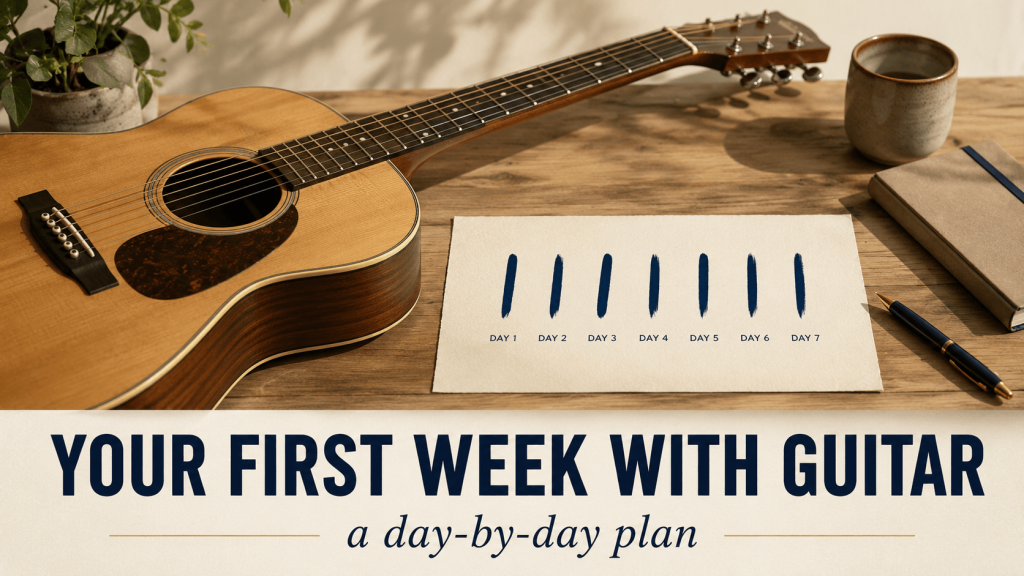
The first week with a new guitar is when most students either build a habit or quit. The decisions you make in these seven days — what to practice, how long, when, and how to handle the inevitable frustration — matter much more than they seem at the time. A good first week sets up the next six months. A bad one ends the journey before it really starts.
This is a practical, realistic day-by-day plan for your first seven days. It assumes you’ve just acquired a guitar (or are about to) and you’ve never played before. The sessions are short — fifteen to twenty minutes a day — because that’s what actually works for beginners. Anything longer in the first week leads to overuse, sore hands, and the kind of frustration that ends in giving up. The plan works for a teenager, an adult beginner, or anyone in between.
| Before you start: If you haven’t already, read How to Hold a Guitar Correctly. Setting up your posture right from session one prevents the pain and bad habits that derail many beginners. Twenty minutes spent on posture in advance saves months of unlearning later. |
Day 1: Meet the Guitar
Today is not about playing music. Today is about getting comfortable with the instrument as an object — what the parts are called, how to hold it, what each string sounds like. Most beginners skip this stage and rush to chords. Don’t. The fifteen minutes you spend today on these basics will make every subsequent session more productive.
What to do today (15-20 minutes)
- Set up your posture (5 minutes). Sit on a firm chair, feet flat on the floor, back straight. The guitar rests on your right thigh (left if you’re left-handed), neck angled slightly upward. Get comfortable in this position before doing anything else.
- Learn the parts of the guitar (3 minutes). Head, neck, body, frets, strings. The strings are named, from thickest to thinnest: E, A, D, G, B, E. Knowing the names matters because they come up in nearly every guitar instruction you’ll ever read.
- Tune the guitar (3 minutes). Download a free tuner app (GuitarTuna, Fender Tune, or BOSS Tuner). Tune each string individually. This will take longer the first time. Get comfortable with the process — you’ll be doing it every session for the rest of your guitar-playing life.
- Play each string one at a time (3 minutes). With a pick or your thumb, play each string slowly. Listen to the sound. Notice how each string has a different pitch and tone. This is the most basic form of ear training, and it matters more than it seems.
- Press a string at the third fret of any string (3 minutes). Just one finger, one string, one note. Try it with each finger. Notice how the note changes from the open string. This introduces the basic mechanic of fretting that everything else builds on.
Don’t worry about
Chords. Songs. Strumming patterns. Sheet music. Anything that feels ambitious. Today is foundation-laying day. The work matters even though it doesn’t sound like much.
Day 2: Your First Chord
Today you learn one chord. Just one. The temptation will be to learn three or four — resist it. A single chord learned thoroughly in week one is worth more than five chords learned superficially.
What to do today (15-20 minutes)
- Warm up (3 minutes). Sit with the guitar, do the string-by-string playing from yesterday. Get your hands moving before attempting anything new.
- Learn Em (the easiest beginner chord) (10 minutes). Em is two fingers on the A and D strings, both on the second fret. Look up a chord diagram if you need the exact positions. Form the shape slowly. Strum each string individually to check that all the open strings ring clearly. If a string sounds muted, adjust your finger position.
- Strum the full chord (4 minutes). Once you can form the shape and have each string ringing clearly, strum across all the strings. The result is your first real chord. Strum it a few times, savor it briefly, then move to the practice loop below.
- The chord-loop practice (rest of session). Form the chord. Strum it. Take your hand completely off the strings. Form the chord again from scratch. Strum it. Repeat. The act of building the chord from nothing is what teaches your hand to find it automatically. Do this 15-20 times.
What to expect
Your fingertips will be sore — possibly quite sore — by the end of today’s session. This is normal. The sensitive skin on your fingertips is not yet used to the pressure of pressing strings. The soreness fades within 2-3 weeks as light calluses form. Don’t push past genuine pain, but a moderate amount of fingertip soreness is part of the process.
Day 3: The First Rough Day
Day 3 is often unexpectedly hard. The novelty of day 1 has worn off. The chord you learned yesterday may feel like it has slipped overnight — your hand can’t quite remember the shape, or the strings buzz now where they rang clearly before. This is normal. Motor learning consolidates partially overnight, but the consolidation is imperfect; you’ll feel some regression.
What to do today (15-20 minutes)
- Warm up (3 minutes). Play each string individually. Form yesterday’s Em chord a few times to refresh the muscle memory.
- Continue practicing Em (10 minutes). Re-do the chord-loop practice from yesterday. The shape should start coming back more easily as the session progresses. By the end of this session it will feel better than it did yesterday — possibly significantly better. This is the second-day effect of motor learning, and it’s the reason daily practice works.
- Add Am (5 minutes). Am is similar to Em — same two fingers, but shifted one string lower. Look up a chord diagram. Form the shape slowly. Strum to check each string. Em and Am are close cousins, and learning them together makes both stick better.
- Try alternating between Em and Am (rest of session). Slowly. Form Em, strum it, take your hand off, form Am, strum it, take your hand off. The switching is going to feel awful. That’s fine. It feels awful for everyone in week one. The repetition is doing real work even though it doesn’t seem like it.
If you’re already discouraged
This is the day the doubts often start. The chord doesn’t sound great. The switching feels impossible. Your fingertips hurt. You wonder if you have the talent for this. Here is the honest truth: nobody plays well on day 3. Not anyone in history. The professional guitarists you admire all had a day 3 where they sounded exactly as bad as you do now. The only thing that separated them from the students who quit was that they kept going. Push through to tomorrow.
Day 4: Building on Two Chords
By today, the muscle memory from your first three sessions should be starting to feel real. Em and Am will form noticeably faster than they did on day 2 or 3. This is the encouraging part — the part where you can start to feel the progress that’s been happening invisibly.
What to do today (15-20 minutes)
- Warm up (3 minutes). Quick string-by-string. Then form Em and Am alternately a few times to refresh.
- Practice the Em-Am switch with timing (12 minutes). Set a metronome app to 50 beats per minute (slow). On beat 1, form Em. On beat 3, form Am. On beat 5, back to Em. Continue. Don’t try to play along to the click as music — just use it to pace your chord changes. The goal is to make each chord change land on the click, no matter how clumsy it feels.
- Try a simple strumming pattern (5 minutes). Take Em (just one chord) and try four even downstrokes per measure — down, down, down, down. Don’t worry about being good at it. Just feel how the strumming hand moves independently of the fretting hand. This is the basic motion that every strumming pattern builds on.
What you might notice
Your fingertips are starting to feel different — slightly tougher, less acutely sore than on day 2. The light calluses are beginning to form. Your hand may also feel more comfortable holding the guitar than it did at the start. These are real signs of progress, even though you can’t yet play anything that sounds like music.
Day 5: Adding a Third Chord
Now you can start to feel the structure of beginner chord practice. Today, add a third chord — D — and start putting all three into rotation.
What to do today (15-20 minutes)
- Warm up (3 minutes). Practice Em and Am individually, then alternate between them a few times. They should feel notably more familiar than they did on day 3.
- Learn D (8 minutes). D is a three-finger shape. The triangle of fingers on the second and third frets. Look up a chord diagram for the exact placement. D is harder to form cleanly than Em or Am — expect more buzz and more wrong notes initially. The third finger position is where most beginners struggle. Form the shape slowly, check each string.
- Practice switching from Em to D (9 minutes). Em to D and back to Em. Slowly. The transition involves picking up your fingers entirely and re-placing them in a different shape — a bigger motion than the Em-Am switch. Use the metronome at 50 bpm again.
On Day 5 plateau
Around now is when many students start to feel like they’re not making progress fast enough. They’re playing one chord cleanly, kind of playing two chords, and learning a third one badly. The math seems wrong — five days in, and only three rough chords? This perception is wrong, but it feels real. Look at where you were on day 1. You had never played guitar. Now you can form three different chord shapes and switch between two of them. The progress is real even though it doesn’t feel like a song yet.
Day 6: Your First Tiny Song
Today’s the breakthrough day. You’re going to play your first song. It won’t sound great. That doesn’t matter.
What to do today (15-20 minutes)
- Warm up (3 minutes). Run through Em, Am, and D quickly. All three should now feel at least somewhat familiar.
- Practice all three chords in rotation (5 minutes). Em → Am → D → Am → Em. Slowly. With or without the metronome. Just get used to the rotation of all three.
- Play your first song (rest of session). Search the internet for any simple two- or three-chord song that uses Em, Am, and/or D. “Horse With No Name” by America uses only Em and D6/F# (close enough to D for a beginner). “Knockin’ on Heaven’s Door” uses G, D, Am, C — but a simplified version uses chords you have. “Stand By Me” uses A, F#m, D, E — too hard for week one. Find something that uses just the chords you know. Strum each chord four times before switching to the next. It will sound rough. You are now playing a song.
This is the breakthrough moment
Playing your first song, however badly, is the single most important psychological milestone in beginner guitar. It connects all the abstract practice from days 1-5 to actual music. Many students describe the moment as the point when they realized this whole thing was possible. Take a moment to recognize the milestone. You’re playing guitar now — slowly, imperfectly, but actually playing. That’s no small thing.
Day 7: Consolidate
Day 7 isn’t about adding new material. It’s about consolidating everything from the week and locking in the habit of daily practice.
What to do today (15-20 minutes)
- Warm up (3 minutes). All three chords in rotation a few times.
- Play yesterday’s song again (10 minutes). It will sound better than yesterday. Possibly noticeably better. The overnight consolidation between day 6 and day 7 often produces a surprisingly large step forward. This is normal and welcome.
- Free practice (7 minutes). Spend the rest of the session doing whatever feels useful. Maybe more chord switching. Maybe trying to find chord shapes that aren’t on the lesson list. Maybe just strumming open strings and enjoying the sound. This unstructured exploration is part of how musicianship develops, and starting it early matters.
What to Do Next
If you’ve made it through all seven days, you’ve already done the hardest part of learning guitar. The habit is built. The instrument is no longer foreign. The chord shapes have started to feel familiar. The plateau coming in weeks 3-4 (which we’ll get to) is still ahead, but you’re in a much better position to navigate it than someone who skipped this foundational week.
From here, the path forward is straightforward, even if it’s not always easy:
- Add more chords gradually. The next ones to add are G and C — they’re harder than Em, Am, and D, but they open up far more songs. See Guitar Chords for Beginners for the full set.
- Add more songs. Once you can play one song badly, the goal becomes playing it less badly, and then learning a second song. Building a small repertoire of songs you can play is what makes practice feel rewarding over the long run.
- Improve strumming. Once you’ve internalized down-down-down-down, try down-down-up-up-down-up. The added complexity will feel impossible at first and then suddenly click within a few weeks.
- Keep showing up daily. The single biggest predictor of guitar success is whether you practice every day, even briefly. Fifteen minutes for the next six months will take you much further than you can imagine right now.
If You Missed a Day
It happens. Life intervenes. Don’t quit because of one missed day, but don’t let one missed day become two.
The honest psychology of habit formation: the first miss is forgivable; the second miss tends to break the streak entirely, because once you’ve missed twice, the habit no longer feels like “my daily practice routine” — it feels like “a thing I sometimes do.” The recovery move after one missed day is to deliberately practice the very next day, even briefly, just to maintain the chain.
If you’ve missed more than a day, don’t try to make up the missed time by practicing twice as long today — that produces fatigue and more bad habits. Just resume the normal session, picking up roughly where you left off. The week-to-week structure of this plan is forgiving; missing a day doesn’t mean restarting.
The Takeaway
Your first week with guitar isn’t about playing well. It’s about not quitting, building the daily habit, and establishing the fundamentals that everything else will build on. A student who completes this week — fifteen to twenty minutes a day, gradually adding three chords, finishing with their first rough song — has a substantially higher chance of becoming a real guitarist than one who tries to do too much, gets discouraged, and quits.
Slow is fast. The unglamorous daily fifteen-minute session is what makes everything else possible. If you’re reading this before starting, trust the plan. If you’re reading it midway through and the week has been harder than expected, that’s also normal — push through. The breakthrough day is closer than it feels.

Further Reading
- How to Play Guitar: A Complete Beginner’s Guide — the pillar article this supports
- Holding the Guitar Correctly — the posture foundation referenced throughout
- Guitar Chords for Beginners — the complete reference for the chord shapes introduced this week