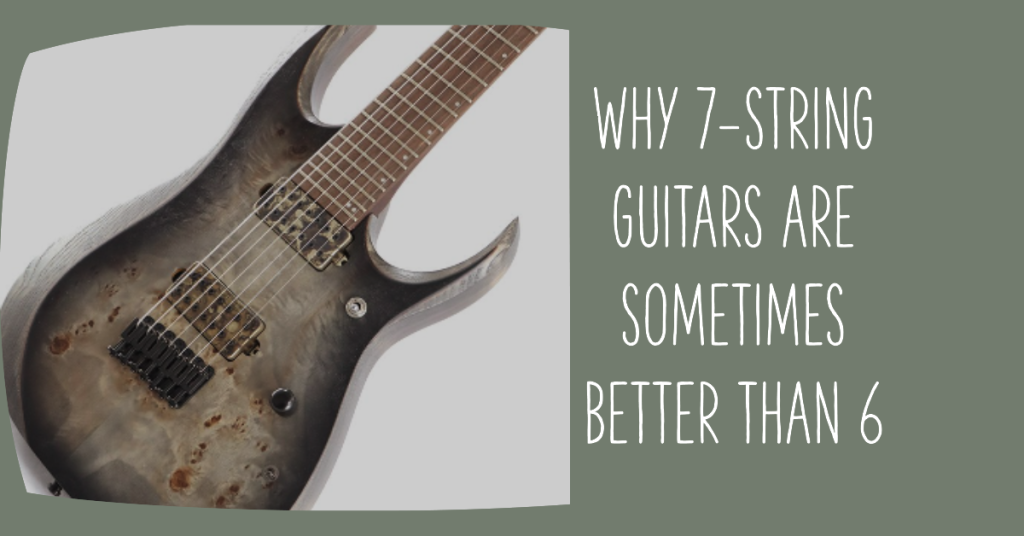
Is a 7-String Guitar Really Better Than a 6-String?
So, a lot of people ask, why would you go with a seven string versus a six string? It’s a valid question. The extra string can seem intimidating, and many people associate it purely with heavy, down-tuned metal. But I’m here to tell you there’s a practical, musical advantage that has nothing to do with genre. Let’s explore why I love to play seven strings versus six.
The Best Tuning for a 7-String Guitar Isn’t What You Think
When players think about extended-range guitars, they often immediately think about alternate or drop tunings. And while those are great, I argue that one of the best tunings for a seven string is actually standard. For this guitar’s sake, I tune standard and then I go a whole step down, but the idea and concept is the same. By keeping that standard B-E-A-D-G-B-E relationship across all seven strings, you unlock a level of symmetry and convenience across the fretboard.
The Problem: Playing Scales on a 6-String Guitar
To really understand the benefit, let’s think about our three-note-per-string scale patterns. These are fundamental building blocks for lead guitar playing, from rock and blues to jazz fusion. Let’s act like we’re playing it on a six string.
The Octave Limit
We remember that there are seven notes in a major scale. So if we play a standard three-note-per-string pattern on a six-string, what am I doing there? I’m playing 1-2-3, 4-5-6, 7-1, 2-3-4, 5-6-7, 1-2-3-4. In other words, I’m only playing roughly 2 and 1 half octaves. To continue the scale and reach the higher octaves, I have to make a significant position shift. I have to move around more to complete the scale, which can interrupt the flow of my playing.
The Solution: The 7-String Advantage
This is where the magic of the seventh string comes in. It’s not just about having lower notes; it’s about completing the pattern and extending your range within a single position.
Completing the Three Octaves
But if we play that same scale on a seven string, and we lower it down and start on that low B, you can see that I complete three full octaves. That low B string provides the exact notes needed to finish the three-note-per-string pattern without that awkward shift. You can fluidly move through a full three octaves, which is a massive advantage for improvisation and writing melodic lines. Your hands stay in one place, but your musical range is significantly wider.
Frequently Asked Questions (FAQ)
- What is one of the best tunings for a seven-string guitar?
I argue that one of the best tunings for a seven string is actually standard, not doing any type of drop tuning. - What is a limitation of playing scales on a six-string guitar?
I’m only playing roughly 2 and 1 half octaves. I have to move around more to complete the scale. - How many notes are in a major scale?
There are seven notes in a major scale. - What is the primary benefit of a seven-string for playing scale patterns?
If we play that same scale on a seven string… you can see that I complete three full octaves.