Somewhere online, you have probably read that there is a chord so unsettling it was banned by the Church, outlawed in composition, or forbidden to play. It is one of music’s most persistent stories, and like most persistent stories it is part true, part exaggeration, and far more interesting once you know which is which.
Here is the honest version: what the sound actually is, what really happened historically, why the myth keeps growing, and the part most articles skip entirely, which is how to play it yourself in about a minute.
The Short Answer
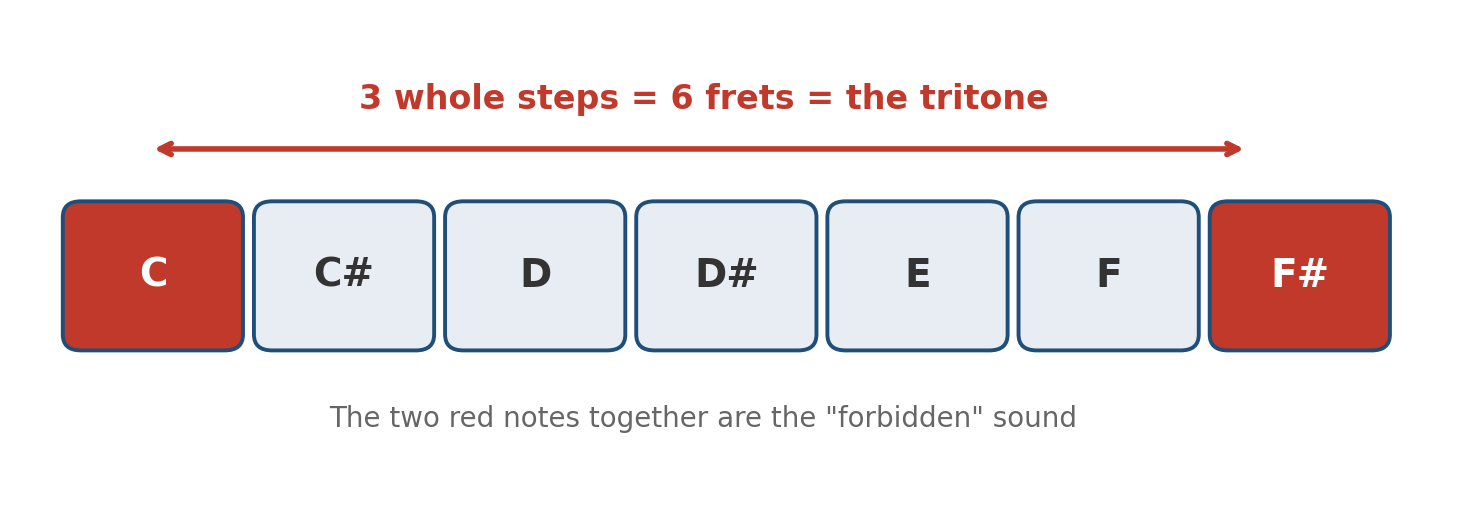
The forbidden chord is not a chord at all. It is an interval, meaning two notes played together, and it is called the tritone. It sits exactly three whole steps apart, which is where the name comes from, and it produces a tense, unresolved, slightly wrong-sounding clash that the ear desperately wants to move somewhere else.
Medieval musicians nicknamed it diabolus in musica, Latin for the devil in music. That nickname is genuinely historical, and it is where the entire legend begins.
Play It Right Now (Four Steps)
Before the history, hear the thing itself. Pick up your guitar.
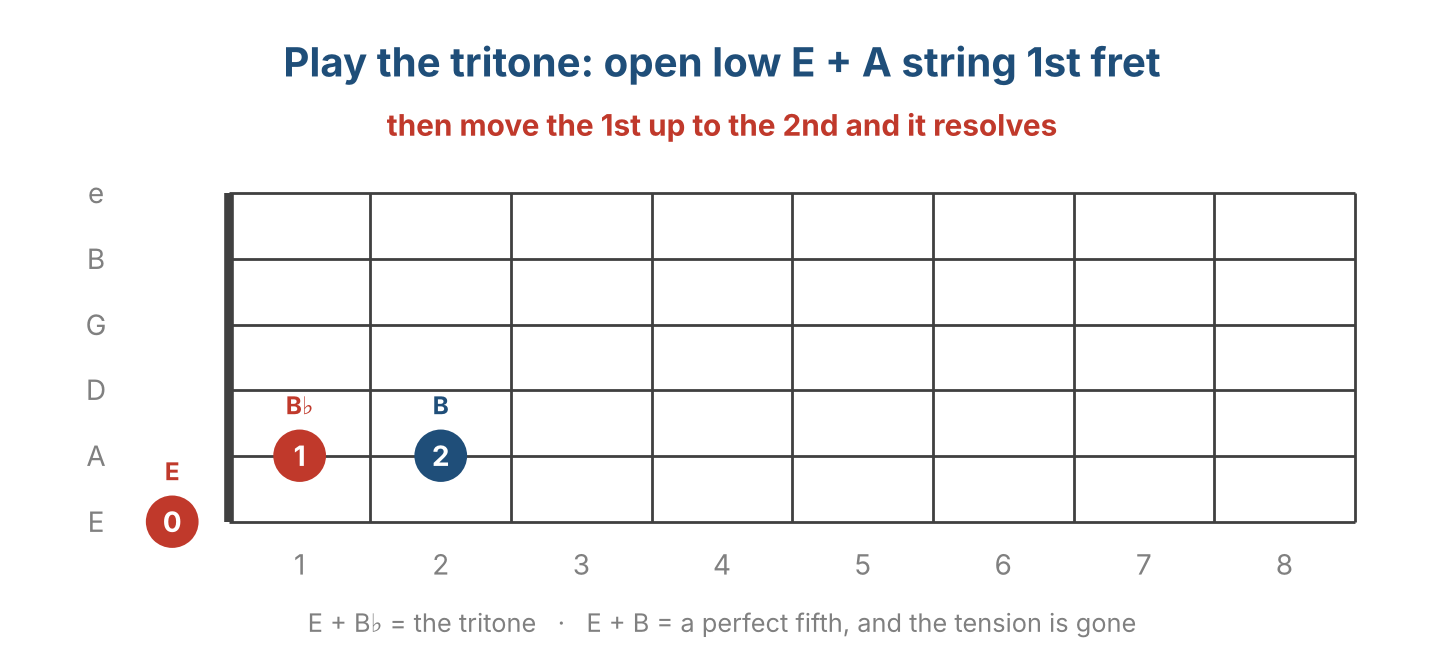
- Play the open low E string on its own and let it ring.
- Play the 1st fret of the A string. That note is B♭, a tritone away from your open E.
- Play both together, open low E and A string 1st fret. That clash is the forbidden sound.
- Now move that second note up one fret to the 2nd. The clash turns into a perfect fifth, and the tension disappears. That contrast is the whole reason the tritone unnerved people for centuries.
That is it. No curse, no ban, no danger. Just two notes with a famously restless relationship.
| The forbidden chord in one line: It is the tritone, two notes three whole steps apart, six frets apart on one string. Medieval musicians called it the devil in music because it refuses to resolve. Play the open low E plus the A string 1st fret and you have played it. |
What Actually Happened Historically
Now the honest history, because this is where most articles drift into fiction.
What is true: the tritone was genuinely avoided in medieval and Renaissance sacred music. The music theory of the period treated it as difficult and dissonant, singers found it awkward to pitch, and the compositional rules of the time steered writers around it. Theorists really did use the diabolus in musica nickname. Sacred music of that era aimed for purity, order and resolution, and the tritone is the opposite of all three.
What is not true: there was never a law banning it, nobody was punished for playing it, and the Church issued no decree outlawing an interval. It was a stylistic convention, taught and followed the way any craft convention is, much closer to we do not write it that way than to prohibition. The dramatic version of the story appears to be a far later invention, and it spread because it is a fantastic story.
Why the Legend Refuses to Die
Three reasons, and they reinforce each other. First, the sound genuinely is unsettling, so anyone who plays the four steps above hears immediately why the nickname stuck, and the myth arrives pre-validated by your own ears. Second, the nickname is real and irresistibly quotable, and the devil in music travels much further than a dissonant interval avoided by convention. Third, the tritone actually is everywhere in the music people associate with darkness. Heavy metal built an identity on it, horror soundtracks lean on it constantly, and jazz uses it as a core ingredient of tension. The legend keeps collecting fresh evidence, even though that evidence proves something different: not that the sound is forbidden, but that it is useful.
Where You Have Already Heard It
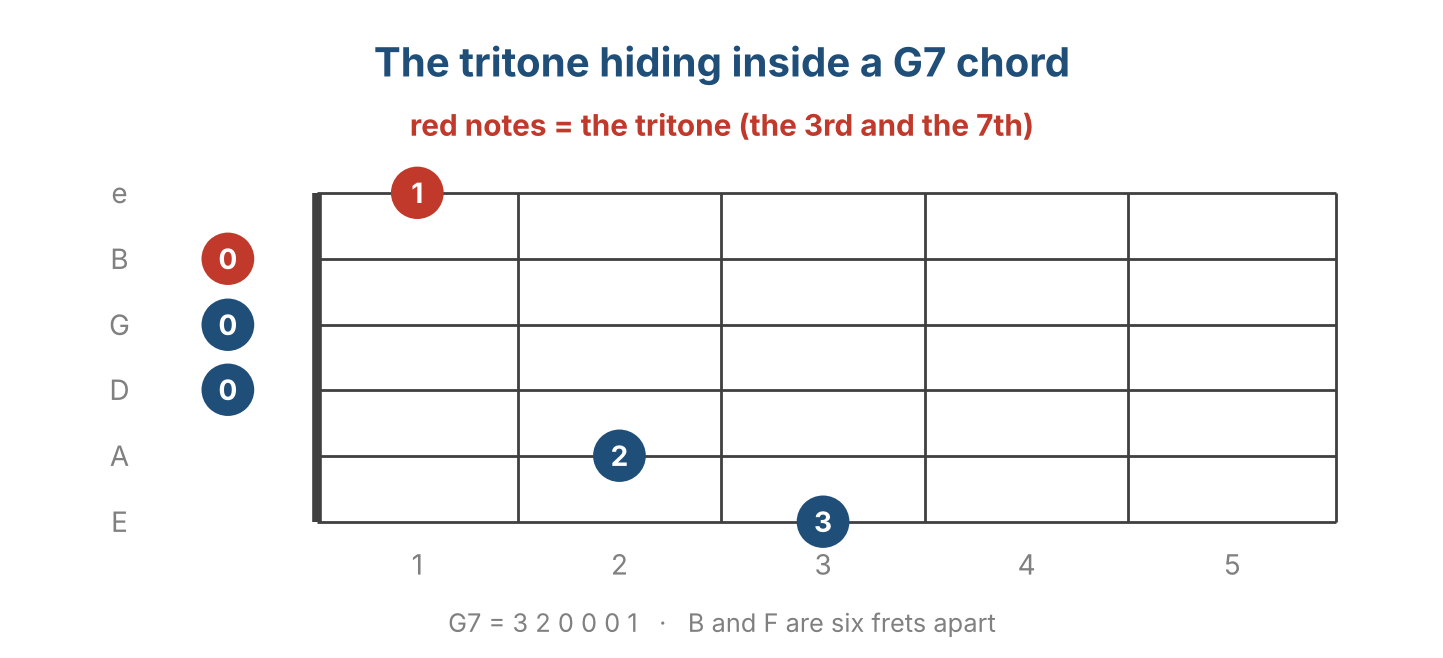
The tritone is not exotic. It hides inside chords you may already play. Every dominant seventh chord, the workhorse of blues, jazz and rock, contains a tritone between its third and seventh notes, which is exactly why a seventh chord sounds like it is leaning forward and wanting to move. Diminished chords contain two tritones stacked together, which is why they sound so unstable. Metal riffs use the interval openly and deliberately. In other words, the forbidden sound is one of the most-used ingredients in modern music, and you have been listening to it your whole life.
How to Actually Use It
- For tension and release: play the tritone, then resolve one of its notes by a half step. That single move is the engine of blues and jazz harmony.
- For dark riffs: play a root note and its tritone as a two-note shape, then move the whole shape around the neck. That is the metal sound in one gesture.
- For colour in chords: any time you play a seventh chord you are already using it. Lean on that chord a beat longer than feels comfortable and hear the pull it creates.
The Takeaway
The forbidden chord is the tritone: a real interval with a real medieval nickname, a genuinely restless sound, and absolutely no ban behind it. It was avoided by convention, not outlawed by decree, and today it sits inside the seventh chords, diminished shapes, and metal riffs that fill modern music. Play the four steps above, hear the clash and then the resolution, and you have hold of one of the most useful tools in harmony. The devil, it turns out, makes a very good session musician.
| Every mysterious sound is just a pattern Tritones, sevenths and diminished shapes all move around the neck as repeatable patterns, which is exactly what Breakthrough Guitar’s Guitar Grid method teaches. Start with the free lesson. Start the free Guitar Grid lesson |
Further Reading
- What Is the Evil Chord? – the chord built from this interval
- What Is the Creepiest Key Signature? – the full toolkit of unsettling sounds
- Unraveling the Music Theory: What Does the 7 in A7 Mean
- What Is the 1-3-5 Chord Rule? – how chords are built in the first place