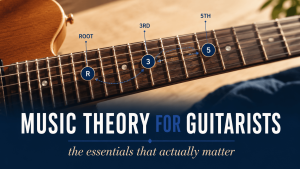
Stop memorizing endless guitar chord shapes… I’ll show you the simple 1-3-5 formula that lets you create ANY major chord easily, anywhere on the fretboard.
Today, we’re going to take that major scale we’ve been working on and use it to unlock the key to building endless, interesting chords. This is how you stop just memorizing shapes and start understanding your guitar.
The Foundation: The Extended Major Scale
The next thing we’re going to do is take that scale and we’re going to extend it across all of the strings. You may have wondered in the past, how is that possible? If we only have seven notes, how do I play three notes on every string? Well, we just keep going up to higher octaves. That’s it. It’s the same notes, they’re just repeated in higher pitches. Same letter, different frequency, different pitch.
Let’s play an extended version of C major.
The Fingering
- Low E string: 8th, 10th, 12th frets
- A string: 8th, 10th, 12th frets
- D string: 9th, 10th, 12th frets
- G string: 9th, 10th, 12th frets
- B string: 10th, 12th, 13th frets
- High E string: 10th, 12th, 13th frets
What I want you to do is ascend this while alternate picking and repeat no notes at the top. Immediately start to come backwards once you hit that top note. I want you to ascend and descend this full C major like this. Great. Excellent. Excellent work there.
The Key to Unlocking Chords: Numbering the Scale
The reason I want you to focus on this in this register here is because this is the key to unlocking how to build chords and figure chords out. So, what we did here was go 1, 2, 3, 4, 5, 6, 7. I want you to do the same here, but I want you to keep counting and adding numbers. So, I want you to go:
1, 2, 3, 4, 5, 6, 7, 8, 9, 10, 11, 12, 13, 14, 15, 16, 17, 18.
Do that out loud 10 times, clean and even. And then I think you’re ready for the next step here.
The Simple Formula: How to Build a Basic Major Chord
Now, in order to understand how to build interesting chords, we must also learn how to build basic chords. So, if we’re sticking to the idea of C major, how do we build a C major chord? Well, it’s easy. We remember these numbers, right?
A major chord is three notes combined: 1, 3, and 5.
That’s it. And you know the numbers at this point from our exercise. So you know that it’s this note, this note, and this note. Let’s play those back and forth so you can hear. 1, 3, 5… little frill at the end. Enjoy.
Those are the notes that make up C major. We know that’s C, E, and G.
The Proof is in the Chord You Already Know
And if you want proof, all you need to look at is your basic C major chord that we all know how to play, where we put that finger on the third fret of the A string, second fret of the D, open G, first fret of the B, and open E.
Let’s look at the notes in that shape:
- That note on the A string is C.
- This note here on the D string is E.
- We have an open G.
- We have another C.
- And we have another open E here.
And that’s just the notes that we called out, right? C, E, G. It’s the 1, 3, and 5 that makes that C major a C major chord.
Your Practice Assignment
So, what I recommend is playing through this just like I did, where you’re playing the first, third, and fifth backwards and forwards. First, third, fifth, third… just going through and getting a good idea of how to play that and what it sounds like.
And then I also want you to play that open C major chord and start to figure out where those C, E, and G notes are. Okay, this is the basis of how we start to build interesting chords. And you can see how we’ve gotten there.

FAQ
- How is a major chord built on the guitar?
A major chord is three notes combined, built from the 1st, 3rd, and 5th notes of its corresponding major scale. - What are the notes in a C major chord?
The notes that make up a C major chord are C (the 1st), E (the 3rd), and G (the 5th). - How can you play a scale across all six strings if there are only seven notes?
You just keep going up to higher octaves. The notes are the same (e.g., C, D, E, etc.), but they are repeated at higher pitches or frequencies. - Why is it important to number the notes of a scale?
Numbering the notes of a scale (1, 2, 3, 4, 5, 6, 7, and so on) is the key to unlocking how to build chords, figure out chord extensions, and understand music theory on the fretboard.