If you’re new to guitar and wondering how to spice up your basic chord vocabulary, learning how to build a major 7 chord is a great step. In this lesson, I’ll walk you through exactly how to take a basic C major chord and transform it into a C major 7—a chord packed with color, emotion, and musical depth.
Whether you’re playing acoustic or electric, major 7 chords are fantastic for adding a smooth, jazzy, or soulful character to your playing. Let’s break this down, step by step.
🎸 What Is a Major 7 Chord?
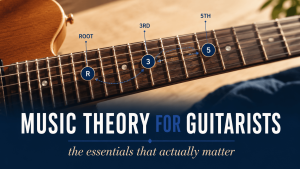
A major 7 chord is simply a major chord with the addition of the major seventh degree of the scale. It consists of four notes:
- Root
- Major third
- Perfect fifth
- Major seventh
In the key of C, this translates to:
- C (root)
- E (major 3rd)
- G (perfect 5th)
- B (major 7th)
That B note is what adds the “major 7” flavor—it creates a dreamy, lush tension that’s often used in jazz, soul, and R&B.
🎼 Step-by-Step: Building a C Major 7 Chord on Guitar
Step 1: Start with the C Major Chord
We begin with a standard open C major chord. If you’ve played guitar even for a short while, this shape will be familiar:
- 3rd fret A string (C)
- 2nd fret D string (E)
- Open G string (G)
- 1st fret B string (C)
- Open high E string
Step 2: Understand the Scale Formula
To find the 7th, count up the C major scale:
C (1), D (2), E (3), F (4), G (5), A (6), B (7)
That “7” is B—the note we need to add to turn our C major into a C major 7.
Step 3: Modify the C Chord Shape
Now, how do we add that B? Here’s the cool part:
If we play the B note on the open B string, and remove the 1st fret (which was another C), we’ve just added the seventh without needing to stretch or bar.
So your new shape is:
- 3rd fret A string (C)
- 2nd fret D string (E)
- Open G string (G)
- Open B string (B)
- Open high E string
This is your C major 7 chord—simplified, effective, and expressive.
You’ll notice right away—the C major 7 has more emotional depth. It sounds smoother, more atmospheric. That’s the power of just one added note.
🎯 Why Use Major 7 Chords?
Major 7 chords give your guitar playing an emotional lift. Here’s where they shine:
- Song Intros: Set the mood instantly.
- Jazz & R&B: A staple chord for soulful, rich harmonies.
- Ballads & Acoustic Jams: Add tenderness and depth to basic progressions.
By simply understanding the formula and modifying the open shape, you’re already sounding more advanced.
🎶 Guitar Theory Behind the Chord
Let’s reinforce what’s happening here:
- The C major chord has the triad: C–E–G
- The major 7 chord adds the 7th note of the C major scale: B
- So now we have: C–E–G–B
From a chord theory standpoint, this is an extension of the base chord. And extensions are what make music sound expressive, sophisticated, and alive.
💡 Pro Tip: Apply This to Other Major Chords
Once you understand how to find the major 7th of a chord using the scale, you can build a major 7 chord from any root. Just follow this pattern:
- Identify the major scale from the root
- Add the 7th note (not flattened!)
- Find where that note is on the fretboard and include it in your chord shape
Try it with G major or D major next!
✅ FAQ: Guitar Major 7 Chords
- What does the “7” mean in a chord?
It refers to the seventh note in the corresponding scale. A major 7 chord uses the natural 7th—not a flat 7 like in dominant 7th chords. - Is Cmaj7 the same as C7?
No. Cmaj7 includes the B note (natural 7th), while C7 includes Bb (flat 7th), making them sound very different. - Why does the Cmaj7 sound emotional?
The major 7th interval creates a smooth, almost unresolved quality that evokes nostalgia and warmth. - Can I play major 7 chords anywhere on the neck?
Absolutely. The theory applies across the fretboard—you just need to find the right voicing that includes root, 3rd, 5th, and 7th. - Do I need barre chords to play major 7s?
No! As shown in this lesson, the open Cmaj7 shape requires no barre and still delivers a beautiful tone.
Final Thoughts
Learning to build major 7 chords on the guitar is one of the easiest ways to evolve from a beginner to a more expressive player. By simply understanding chord construction and identifying key scale tones, you can create lush, emotional sounds that captivate listeners.
Next time you see a chord like Cmaj7, don’t be intimidated—it’s just your regular C chord… with a little extra soul.