How to Create ANY Major Guitar Chord Easily: Step-by-Step Guide
Creating major chords on guitar can seem tricky at first, but with the right approach, it becomes incredibly easy. I’m going to show you exactly how to build any major guitar chord using a simple counting method. Let’s dive in!
Extending the Scale Across All Strings
First, we take the major scale and extend it across all strings. You might have wondered, how can we play three notes on each string when there are only seven notes in a scale? The trick is repeating notes at higher octaves. The notes remain the same, just at different pitches.
Let’s use the C major scale as an example:
- Low E String: 8th fret (C), 10th fret (D), 12th fret (E)
- A String: 8th fret (F), 10th fret (G), 12th fret (A)
- D String: 9th fret (B), 10th fret (C), 12th fret (D)
- G String: 9th fret (E), 10th fret (F), 12th fret (G)
- B String: 10th fret (A), 12th fret (B), 13th fret (C)
- High E String: 10th fret (D), 12th fret (E), 13th fret (F)
Practice ascending and descending this scale with alternate picking. Doing this builds the foundation you need for chord construction.
Counting the Notes
Once you master playing this scale, the next important step is to count the notes numerically from 1 to 18. For instance:
- Count aloud: 1 2 3 4 5 6 7 8 9 10 11 12 13 14 15 16 17 18
Repeat this ten times clearly and evenly to internalize the positions and pitches of these notes.
Building Basic Chords: The Major Chord Formula
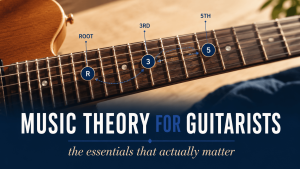
To construct a major chord, we combine three specific notes from the scale:
- Notes 1, 3, and 5 from the scale.
Using the C major example, these notes would be C (1), E (3), and G (5).
Play these notes individually and together to understand their sound clearly:
- C (Root), E (Major third), G (Perfect fifth)
Understanding the C Major Chord
Let’s put theory into practice by examining the familiar open C major chord:
- A String: 3rd fret (C)
- D String: 2nd fret (E)
- G String: open (G)
- B String: 1st fret (C)
- High E String: open (E)
When we strum this chord, we’re simply playing the notes we’ve already identified—C, E, and G. Recognizing this helps demystify the guitar fretboard and chord construction.
Mastering Chord Positions
Practice playing the root (1), third (3), and fifth (5) in different orders to become comfortable with their sounds and positions. For example:
- 1–3–5, then 5–3–1, 1–3–5, and so forth.
This routine enhances your ear training, finger dexterity, and familiarity with chord structures.

FAQ
- How many notes are in a major chord?
- Three notes: the root (1), the major third (3), and the perfect fifth (5).
- Why do we count up to 18 in the scale exercise?
- Counting beyond seven helps you familiarize yourself with note repetition at higher octaves.
- What are the notes in a C major chord?
- C, E, and G.
- Why should I practice alternate picking when ascending and descending scales?
- Alternate picking improves speed, accuracy, and coordination.
- How does understanding scale positions help me build chords?
- Knowing scale positions lets you easily find chord tones and construct chords anywhere on the fretboard.
By mastering these fundamentals, you’re on your way to effortlessly building any major chord on your guitar!