Most guitarists have a complicated relationship with music theory. Either it sounds like homework for a subject you never signed up for, or you’ve tried a few times and drowned in terminology that never seemed to touch the instrument in your hands.
Here’s the good news, and I say this after twenty years of teaching: the amount of theory you actually need as a guitarist is small, it’s genuinely interesting, and it maps onto the fretboard better than it maps onto a page of notation. You can learn the lot in an afternoon and spend the rest of your life getting value from it.
This guide covers exactly that. No notation reading required, nothing included that you won’t use, and every idea tied straight back to the neck.
Why Theory Is Worth Your Time
Theory doesn’t make you a better player on its own. Practice does that. What theory does is make everything else faster to learn, because it turns a pile of memorized shapes into a system that makes sense.
With a little of it, you’ll understand why chords sound the way they do, why certain chords belong together in a song, which notes will sound right when you solo, and how to move a shape you know into any key you like. Without it, you’re memorizing. With it, you’re understanding. The difference compounds over years.
1. The Musical Alphabet
All of Western music uses twelve notes. That’s the entire alphabet.
Seven of them have letter names, A through G, and the five in between are the sharps and flats. On a guitar, each fret is one step up this ladder. Play the 5th fret, then the 6th, and you’ve moved exactly one place along.
There’s one quirk worth knowing: between most letter notes there’s a sharp or flat in between, but between B and C, and between E and F, there’s nothing. They sit right next to each other. This catches everyone out at first, and it’s the reason the pattern isn’t perfectly even.
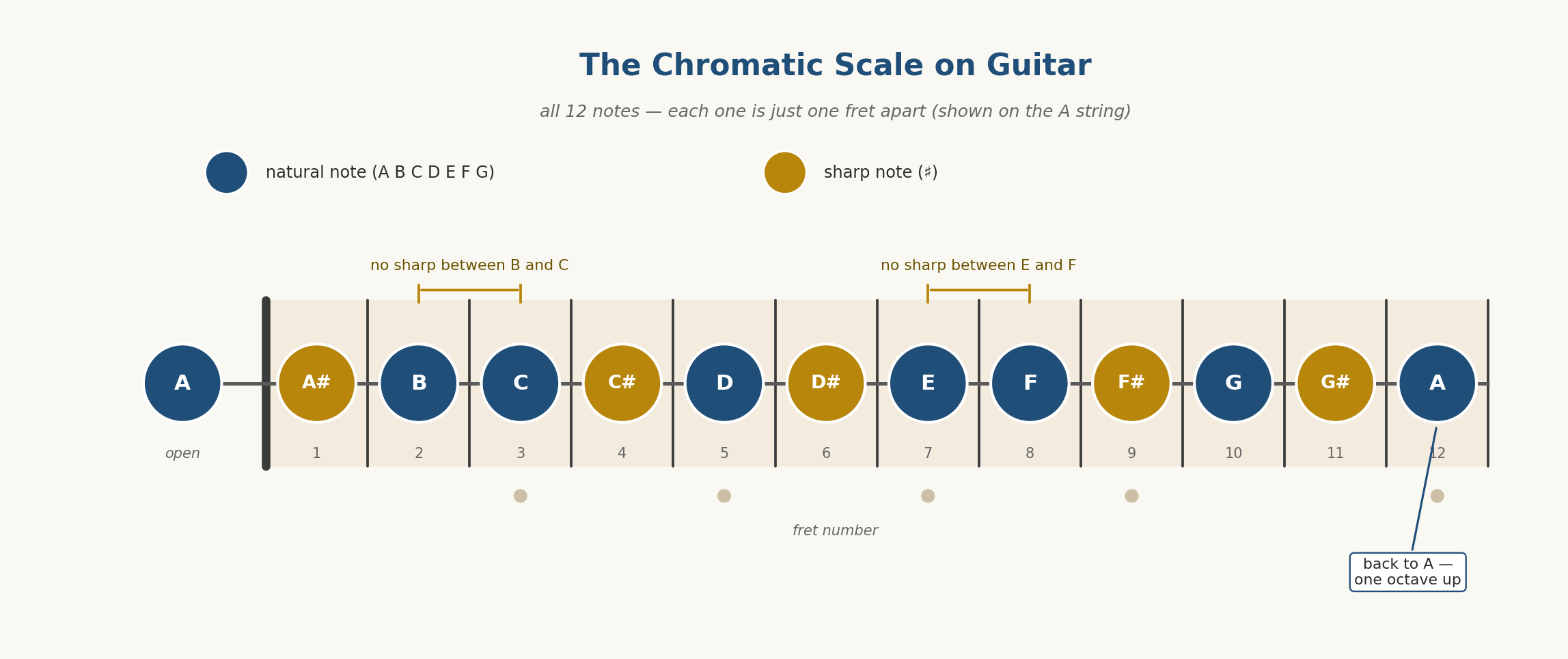
— the twelve notes, showing where B-C and E-F sit with no note between them
On guitar, the practical version is simple. One fret is a half step. Two frets is a whole step. That’s the measuring system for everything else in this article.
2. Intervals: The Distance Between Notes
An interval is just the gap between two notes, counted in frets. This is the most useful idea in all of guitar theory, because the guitar is built on intervals rather than note names.
The ones you’ll meet constantly:
- Half step (1 fret). The smallest move. Played together, two notes a half step apart clash hard, which is why horror soundtracks love it.
- Whole step (2 frets). The basic building block of scales.
- Major third (4 frets). The interval that makes a chord sound happy.
- Minor third (3 frets). The interval that makes a chord sound sad. One fret of difference, an entirely different emotion.
- Perfect fifth (7 frets). Rock solid and neutral. This is the backbone of power chords.
Here’s why intervals matter more on guitar than on almost any other instrument: an interval is a physical shape on the neck. A perfect fifth looks the same whether you play it at the 3rd fret or the 10th. Learn the shape once and it works everywhere, which is the single biggest advantage guitarists have over piano players when it comes to theory.
3. The Major Scale: The Measuring Stick
Almost all Western music theory is described in relation to the major scale, so it’s worth knowing how one is built.
A major scale is seven notes, built by following one fixed pattern of steps: whole, whole, half, whole, whole, whole, half.
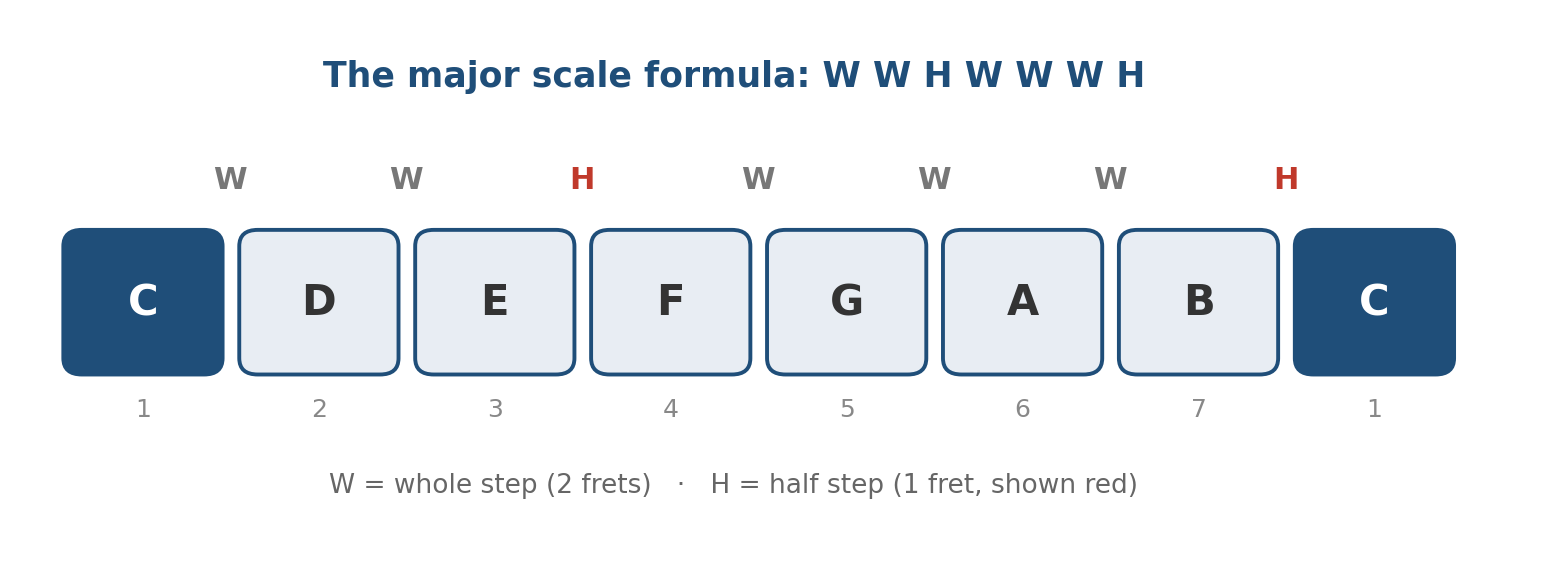
— the major scale pattern: W W H W W W H, shown in C
Start on C and follow that pattern and you get C, D, E, F, G, A, B, which is why C major has no sharps or flats. Start anywhere else and the same pattern produces that key’s scale, sharps and flats included.
Number those seven notes 1 to 7. Those numbers, called scale degrees, are the vocabulary for everything that follows. When a musician says ‘the fifth’ or ‘the flat third’, this is what they mean.
4. How Chords Are Built
This is where theory starts paying for itself immediately.
Take a major scale, number the notes, then play the 1st, 3rd and 5th together. That’s a major chord. In C major that gives you C, E and G, which is every C major chord you’ve ever played, in every position on the neck.
Change which degrees you use and you get every other chord type:
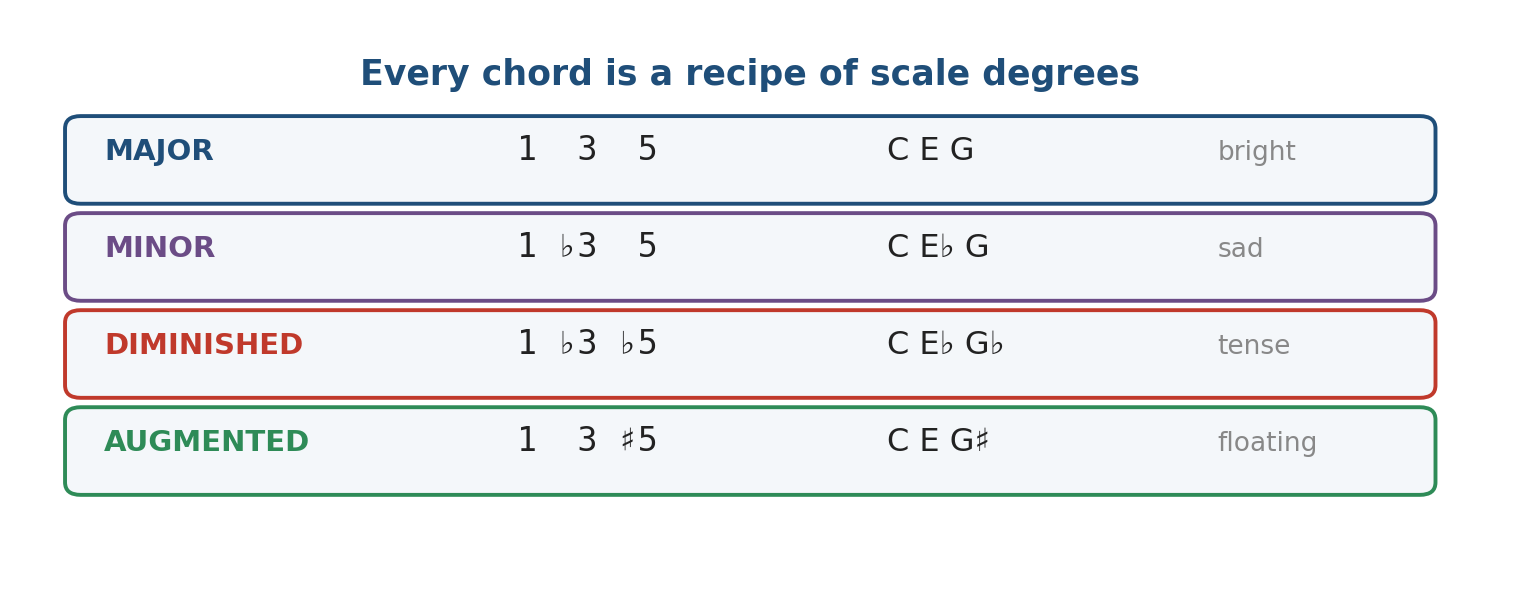
— major, minor, diminished and augmented as recipes of scale degrees
Notice the pattern. Lower the 3rd and a major chord becomes minor. Lower the 5th as well and it becomes diminished. Raise the 5th instead and it becomes augmented. One note is the difference between happy and sad, and it’s the 3rd doing the work every time.
Add more degrees and you get the richer chords. Add the 7th and you get a seventh chord, the bluesy one. Add the 9th for a lush modern colour. Swap the 3rd for the 4th and you get a suspended chord, which sounds unresolved because the note that decides the mood is missing. Every chord name you’ve ever seen is a set of instructions in this system.
| The single most useful thing on this page: Number a major scale 1 to 7. Play notes 1, 3 and 5 together and you have a major chord. Flatten the 3 and it’s minor. Every other chord is a variation on that one idea. |
5. Keys and Why Certain Chords Belong Together
A key is simply a home base: a scale, plus the chords built from it. This is the piece that explains why songs use the chords they use.
Build a chord on each degree of a major scale and you get seven chords that all belong together. In the key of G, that’s G, Am, Bm, C, D, Em and one diminished chord you’ll rarely need.
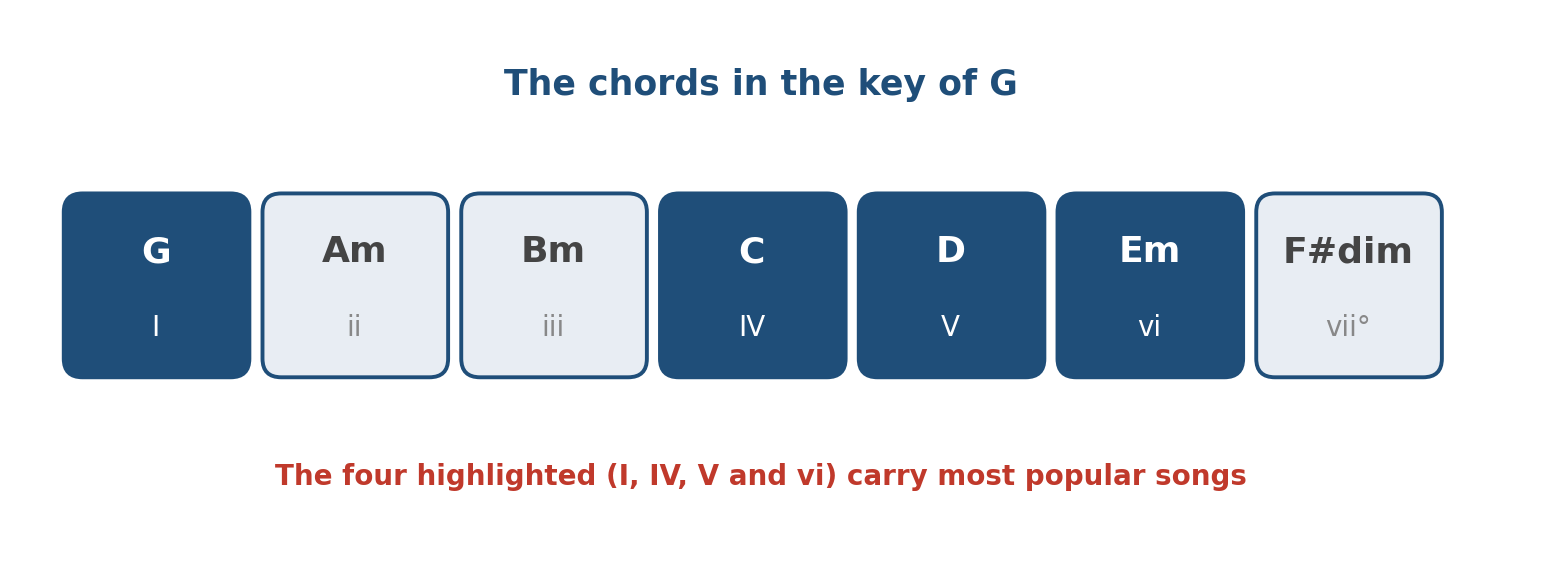
— the seven chords in the key of G, with the four most-used highlighted
Four of those do most of the work: the 1, 4, 5 and 6. In G, that’s G, C, D and Em. Learn to spot that group and you’ll start recognising the harmonic skeleton of an enormous number of songs, because the same four chords in different orders account for a remarkable share of popular music.
This is also the fastest practical payoff of theory. If you know a song is in G, you already know which chords are likely coming, and which notes will sound right if you solo over it.
6. Relative Major and Minor
Every major key has a minor twin that uses exactly the same notes. They’re called relative keys, and the only difference is which note feels like home.
To find the relative minor of any major key, count down three half steps from the root, or count up to the 6th degree of the scale. C major and A minor share all the same notes. G major and E minor are the same pair.
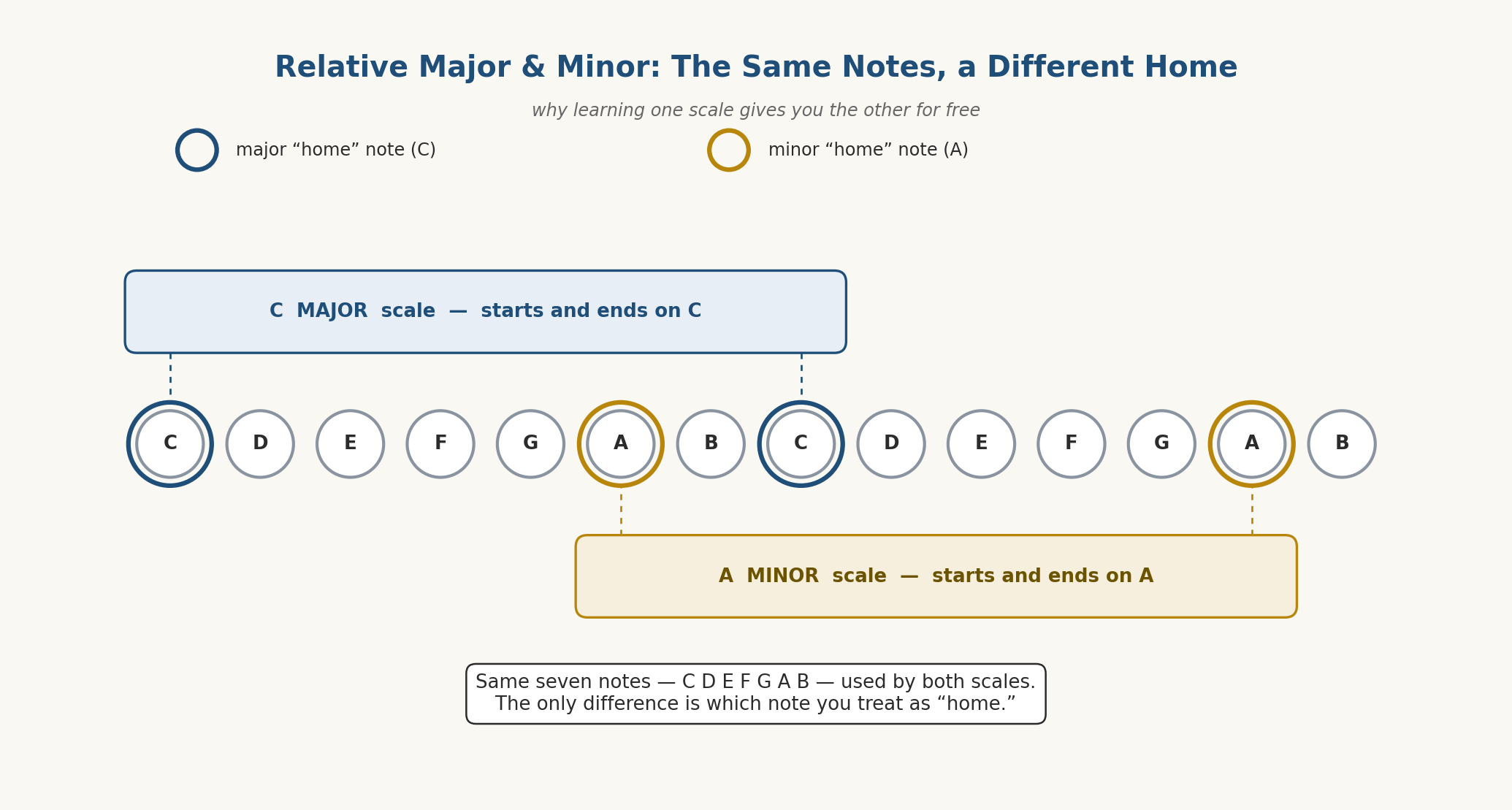
— how each major key shares its notes with its relative minor
For guitarists this is a genuine gift, because it means one scale shape covers two keys. The pentatonic box you learned for A minor is the same box you’d use over a song in C major. You just resolve to a different note.
7. The Guitarist’s Advantage: Shapes Move
Here’s the idea that ties everything together, and it’s the reason theory is easier on guitar than people expect.
Because the fretboard is laid out in consistent intervals, every shape you learn is movable. A barre chord shape at the 1st fret is F. Slide it to the 3rd and it’s G. The shape doesn’t change, only its position. The same is true of scale patterns, arpeggios and interval shapes.
On a piano, every key looks different and you learn twelve versions of everything. On a guitar, you learn one shape and move it. Theory tells you what the shape is doing and where to move it to, which is exactly why the combination of theory plus movable patterns is so powerful.
How to Actually Learn This (Four Steps)
- Build chords by hand. Take the C major scale, pick out notes 1, 3 and 5, and find them on the neck. Then do it for G and D. Half an hour of this teaches more than any amount of reading.
- Work out the key of songs you already play. Look at the chords, find the group of four they belong to, and name the key. You’ll start seeing the same patterns everywhere.
- Learn one scale shape and move it. The minor pentatonic box is the standard starting point. Learn it once, then move it to different frets and notice that it still works.
- Apply it the same week. Theory you don’t use is theory you forget. Each time you learn something here, find it in a song you’re already playing.
The Takeaway
The theory a guitarist genuinely needs comes down to this. Twelve notes make the alphabet. Intervals are the distances between them, and on guitar they’re physical shapes. The major scale is the measuring stick, built on W W H W W W H. Chords are recipes of scale degrees, where 1, 3 and 5 make a major chord and flattening the 3 makes it minor. A key is a scale plus the chords that come from it, with four of them doing most of the work. Relative major and minor share notes, so one shape covers two keys. And because the neck is built on consistent intervals, every shape you learn is movable.
That’s it. That’s the working set. Learn those seven ideas and you’ll understand what your hands have been doing all along, and you’ll learn everything that comes next considerably faster.
| See the theory on the neck, not on the page Everything above becomes practical the moment you can see where the notes live. That’s exactly what Breakthrough Guitar’s Guitar Grid method teaches: the movable patterns that turn theory into something your hands can use. Start with the free lesson. Start the free Guitar Grid lesson |
Further Reading
- What Is the 1-3-5 Chord Rule? – the chord-building idea in full detail
- Guitar Scales for Beginners – the pillar guide to scales, the foundation this theory builds on
- Pentatonic Scale Guide – the scale where the major and minor relationship becomes immediately practical
- Guitar Chords for Beginners – the chords whose construction this article explains
- Open Chords vs Barre Chords – movable shapes, which are interval patterns in action –